
If you’ve been living this aesthetic for more than a season, you’ve probably noticed that most “gothic jewellery” content is written for someone who isn’t you. It’s Halloween shopping guides. It’s “10 spooky rings under £15” listicles aimed at a costume, not a wardrobe. None of it assumes you might actually want to build something considered.
As an Amazon Associate I earn from qualifying purchases and sometimes recommend products from other sellers at no extra cost you. For more details see my disclosure policy and privacy policy. Posts may contain AI generated images to illustrate the content.
This guide does. Think of it less as a shopping list and more as a framework: three ring categories worth understanding properly, how they work together on the hand, and how to tell a piece that will last a decade from one that will go green by December.
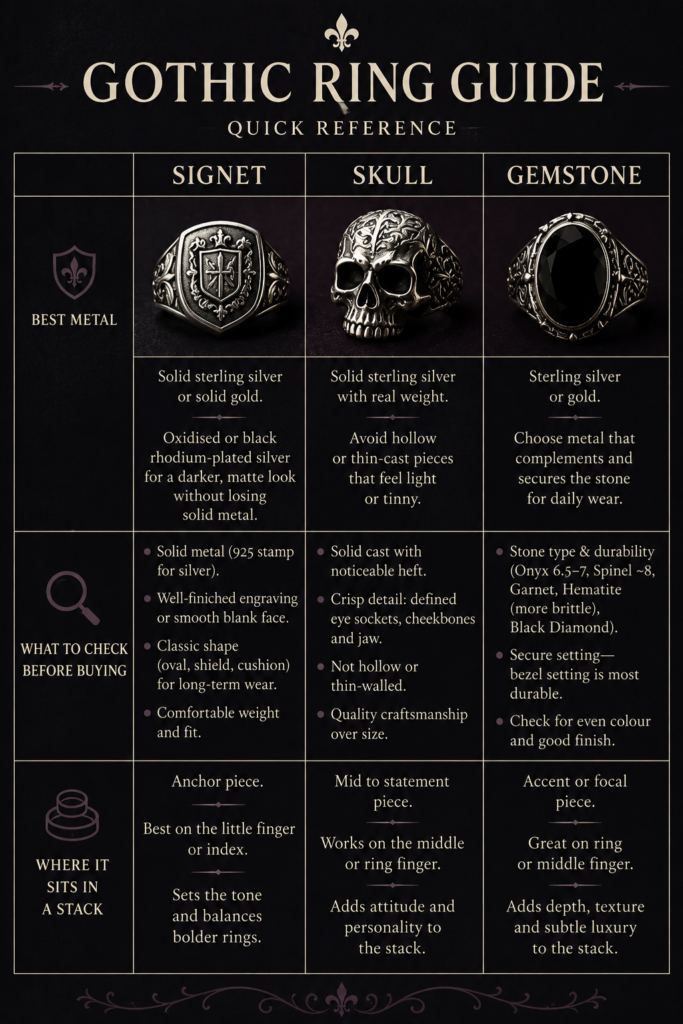
🔏 Signet Rings: The Heraldic Anchor
The signet ring has the longest pedigree of anything in this guide. Its use stretches back to seal-stamping in the ancient world, but the version most of us recognise, engraved with a crest or monogram and worn to press into wax, took shape in medieval and early modern heraldry. Nobility used them to authenticate documents and letters; the ring itself functioned as a signature, cut in reverse (intaglio) so the imprint read correctly on the wax. Some were destroyed on their owner’s death specifically so no one else could use the seal. That’s a lot of weight for a small piece of metal, and it’s exactly why the signet still reads as gothic staple rather than passing fashion piece: it carries actual history, not just an aesthetic borrowed from one.
For our Victorian Mourning Jewelry piece, we went deep on how the Victorians turned personal jewellery into a form of record-keeping and remembrance. Signet rings sit in that same lineage: worn for identity and meaning first, decoration second.
Midnight Decor
3D printed gothic pieces
Darkly beautiful objects for the gothic home — printed fresh when you order. Each piece is conjured for your space and entirely yours.


What separates a signet that reads as heirloom from one that reads as costume comes down to two things: metal and face treatment.
- Metal: Solid sterling silver or solid gold hold their edge and colour for decades. Oxidised or black rhodium-plated silver gives you the darker, more matte look a lot of gothic styling wants, without sacrificing the underlying solid metal.
- Face: A blank or monogrammable oval, shield, or cushion face wears better long-term than a stock “gothic” motif, because you can have it engraved with an initial, symbol, or left plain and let the shape do the work.
A plain engravable oval sterling silver signet is a genuinely useful place to start if you don’t own one yet. It reads as considered rather than themed, and it’s the one ring in this whole guide that will still make sense with you in twenty years.
💀 Skull Rings: From Subtle Signal to Statement
Skull rings have the widest range of any category here, and that range is exactly why they get such a bad reputation. At one end you’ve got a small, finely detailed skull worked into a band, barely visible unless someone’s looking closely. At the other, you’ve got a chunky, hollow-cast novelty piece that belongs on a costume rack. Both are “skull rings.” Only one belongs in a serious collection.
The line between them is craftsmanship, not size. A well-made skull ring, even a large one, is cast in solid metal with defined detail: eye sockets with actual depth, cheekbone structure, a jaw that doesn’t look melted. A costume piece is usually cast thin and hollow to keep material costs down, which is also why it feels light and tinny in the hand and why the finish wears through fast.
If you’re easing in, start subtle: a small skull worked into a signet-style band or set as an accent beside a stone reads as intentional, not novelty. If you want a statement piece, look for a jeweller who specialises in fine detail casting rather than a mass costume supplier, and check the weight before you buy. A genuinely solid sterling silver skull ring has real heft; a hollow one doesn’t.
⚫ Gemstone Rings: Choosing Stones That Read as Gothic
Dark stones do a lot of quiet work in a gothic ring collection. They’re the category most likely to look expensive even when they aren’t, provided you choose well.
Black onyx is the most accessible option: a chalcedony variety with a uniform, deep black colour and a hardness of 6.5 to 7 on the Mohs scale, durable enough for daily wear. Black spinel sits a step up in both rarity and hardness (around 8 on the Mohs scale), which makes it more scratch-resistant, and it’s increasingly used as a black diamond alternative for exactly that reason. Garnet usually reads red, but rare black garnet varieties exist and bring genuine depth rather than flat colour. Hematite, with its metallic iron-oxide lustre, is a good accent stone but is more brittle than the others, so it’s better suited to a protected setting than an everyday knock-about ring. And true black diamonds get their colour from natural internal inclusions, which is a fair chunk of why they cost what they do.
Setting style matters as much as the stone. A bezel setting, where a rim of metal wraps fully around the stone, is both the most durable option for daily wear and the one that reads most gothic: it gives the stone a solid, architectural frame rather than the delicate prong settings you’d see on a conventional engagement ring. We covered more of this territory, including cut and carat considerations, in our dark gemstones guide if you want to go further into stone selection specifically.
A bezel-set black onyx in solid sterling silver is the easiest gemstone entry point: durable, genuinely dark, and priced sensibly enough that it doesn’t feel like a gamble.
⛓️ Stacking and Mixing Without It Looking Cluttered
This is where most ring collections go wrong. Three good rings, worn badly, look messier than one good ring worn alone.
A few working rules:
- Pick a dominant metal, then allow one accent. If silver is your base, one warm gold or brass piece reads as intentional. Three competing metals reads as indecisive.
- Let one ring lead per hand. Your signet or your largest gemstone piece should be the visual anchor; skull and thinner band rings sit around it as support, not competition.
- Vary width, not just style. A stack of same-width bands blurs together. Mixing a wider signet with a slim gemstone band and a fine skull accent gives the eye somewhere to land.
- Leave a finger bare. Counterintuitively, one ring-free finger on each hand makes a fuller stack look styled rather than crowded.
Our gothic accessories piece goes into more of this restraint-versus-statement thinking if you’re building out beyond rings into the rest of your jewellery box.
🔍 Quality Signals: Spotting Well-Made vs Cheap
The good news is that ring quality is genuinely easy to check before you buy, once you know what to look for.
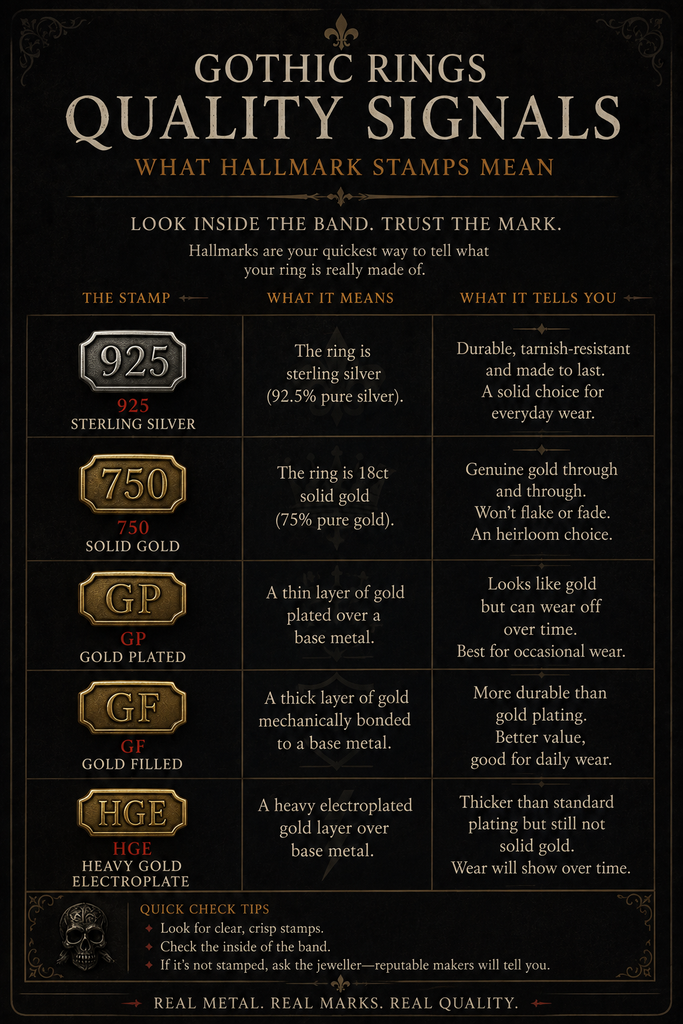
Check the hallmark. A stamp inside the band tells you what you’re actually buying. “925” means sterling silver (92.5% pure silver). “750” means 18-carat gold. If you see letters like GP, GF, RGP, or HGE alongside a number, that’s plated or filled metal, not solid, and it will wear through with contact and time.
Weigh it in your hand. Solid metal has heft. A ring that feels suspiciously light for its size is very likely cast hollow.
Look at the finish under light. Cheap plating often has a slightly uneven, almost plasticky sheen. Solid metal and good rhodium or oxidised finishes hold a more consistent, deeper colour.
Ask what the base metal is. Costume pieces are frequently brass, aluminium, or copper underneath, all of which tarnish fast and can cause skin irritation with extended wear. Solid sterling silver, gold, and stainless steel don’t carry that risk.
Care matters once you own it. Sterling silver and oxidised finishes both benefit from a proper anti-tarnish polishing cloth rather than generic jewellery wipes, especially on pieces you wear daily. A five-minute polish every few weeks keeps a solid piece looking new for years, which is more than you can say for anything plated.
🕯️ Building the Collection: Your Starting Three
If you’re starting from nothing, resist the urge to buy five rings in one order. Build with intent instead.
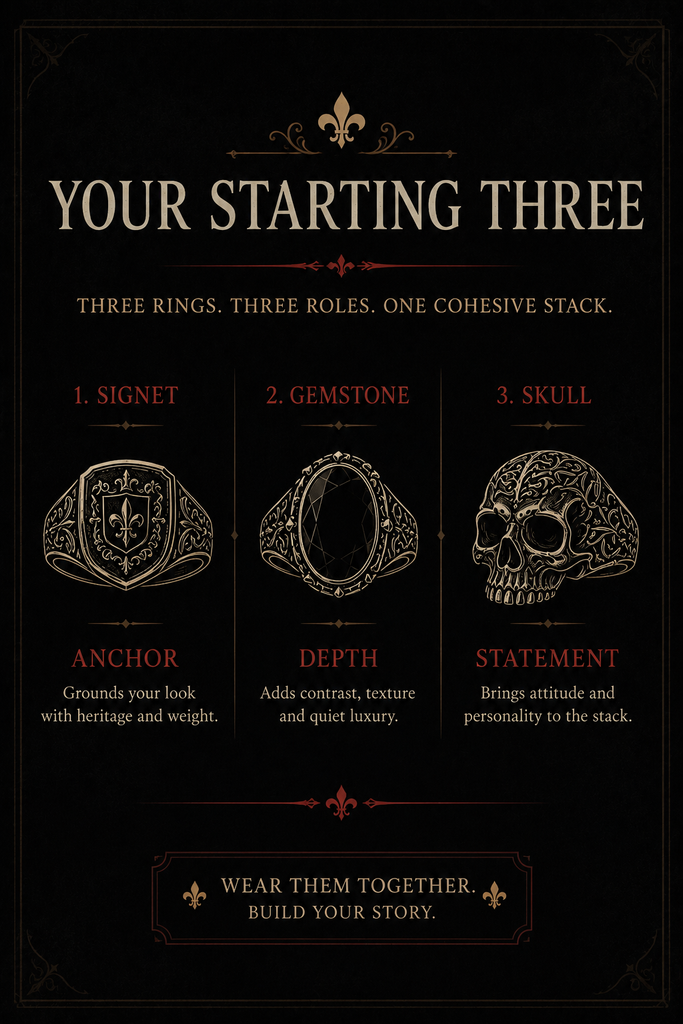
- One signet, solid metal, plain or monogrammed face. This is your anchor piece and the one that will outlast every trend cycle.
- One gemstone ring, bezel-set, in onyx or spinel. This is your everyday depth piece, dark enough to read as gothic, durable enough for daily wear.
- One skull ring, chosen for detail and weight over size. This is where you let a bit of statement in, once the foundation is solid.
Everything after that is refinement, not requirement. A collection built this way, three considered pieces rather than a drawer of costume metal, will actually get worn, which is the whole point.
This guide covers styling principles and material knowledge, not the paranormal or esoteric side of gothic collecting. If it’s crystals-as-ritual-objects you’re after rather than crystals-as-jewellery, that’s a different piece for a different day.