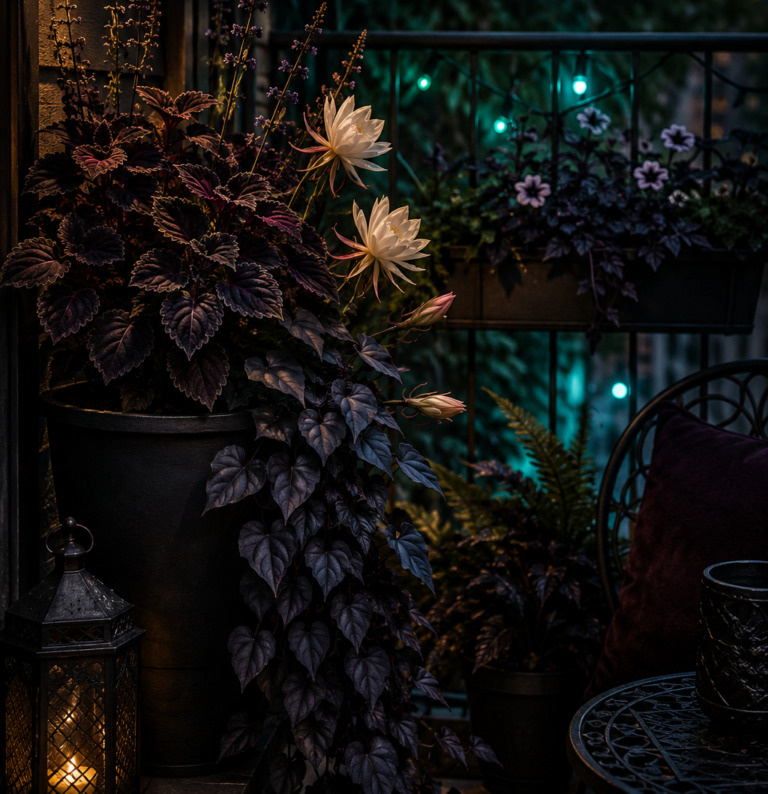
What should a gothic entryway actually do? Set the tone for everything that follows it. The entryway is the first design statement a visitor reads, and most gothic interiors guides skip straight past it to the living room, treating the hallway as leftover space between the front door and the rooms people actually photograph.
As an Amazon Associate I earn from qualifying purchases and sometimes recommend products from other sellers at no extra cost you. For more details see my disclosure policy and privacy policy. Posts may contain AI generated images to illustrate the content.
That’s a mistake. A narrow, low-light, high-traffic hallway is a harder design problem than an open living room, and getting it right does more for the feel of a home than another moody bookshelf ever will.
This guide treats the entryway as its own project, with lighting, furniture, wall treatment and layering choices suited to the specific constraints of a transitional space, plus renter-friendly versions of everything for readers who can’t repaint or rewire.
🚪 Why the Entryway Carries More Weight Than It Gets Credit For
Every room in a gothic home gets judged on its own terms except the hallway, which somehow has to represent the whole house in the thirty seconds it takes to walk through it. It’s the space a guest sees before they’ve decided how they feel about the rest of your décor, and first impressions in interior design work the same way they do everywhere else: fast, and hard to undo.
Midnight Decor
3D printed gothic pieces
Darkly beautiful objects for the gothic home — printed fresh when you order. Each piece is conjured for your space and entirely yours.


There’s also a practical reason hallways matter more than they’re given credit for. They’re transitional by nature, narrow, often windowless or dimly lit, and used constantly, which means design choices that work beautifully in a spacious room can actively work against you here.
A hallway that’s overfurnished feels like an obstacle course. One that’s underlit feels like a corridor in a building you’re trying to leave. Getting a gothic entryway right means solving for the room’s actual constraints rather than shrinking down a living room plan and hoping it survives the move.
🕯️ Lighting Solutions for Dark, Narrow Hallways
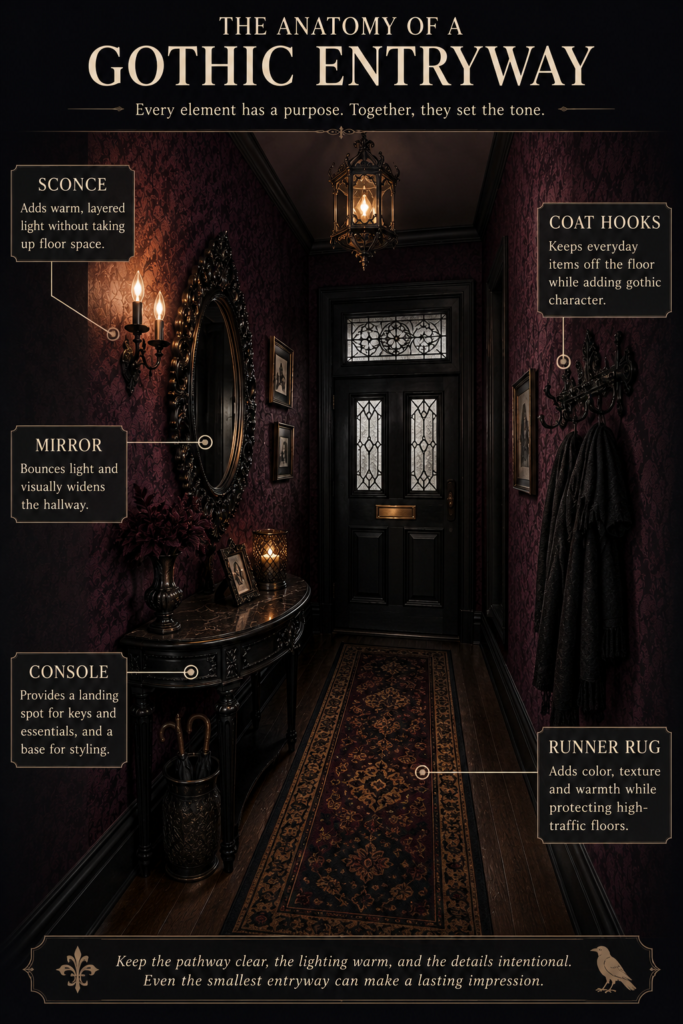
Lighting is the single highest-impact change you can make to an entryway, and it’s also where gothic decor most often goes wrong, because “dark and atmospheric” gets confused with “difficult to see in.” A hallway needs enough light to function. The gothic aesthetic comes from the fixtures and the quality of the light, not the absence of it.
Wall sconces solve the narrow-hallway problem better than almost anything else, because they add light without eating into already-limited floor space. Candle-style sconces with warm, low-wattage bulbs (or genuine flame if your household’s comfortable with that) give the classic gothic glow without the stark brightness of an overhead fixture. Space them at intervals along the wall rather than clustering them near the door, so the light carries the eye down the length of the hallway instead of stopping dead a few feet in.
Statement pendants work if your hallway has the ceiling height to support one without becoming a hazard for anyone over six feet tall. A single ornate pendant partway down a long hallway acts as a punctuation mark, somewhere for the eye to land, and it’s a strong option for hallways with a slight widening or a landing partway along.
For anyone renting or not ready to touch the wiring, plug-in sconces have improved considerably and now come in genuinely convincing candle-style and wrought-iron designs. They sit on existing outlets, no electrician required, and can be removed cleanly at the end of a tenancy. Battery LED taper candles in wall-mounted holders are the fallback option where there’s no outlet nearby at all, and modern versions flicker convincingly enough that most guests won’t clock the difference.
Whatever fixture you choose, warm-temperature bulbs (2700K or lower) do more for the gothic mood than the fixture design itself. A beautiful wrought-iron sconce with a cold white bulb in it reads like an office corridor. The same fixture with a warm, dim bulb reads like something out of a Victorian townhouse.
🪞 Statement Furniture and Fixtures for a Working Hallway
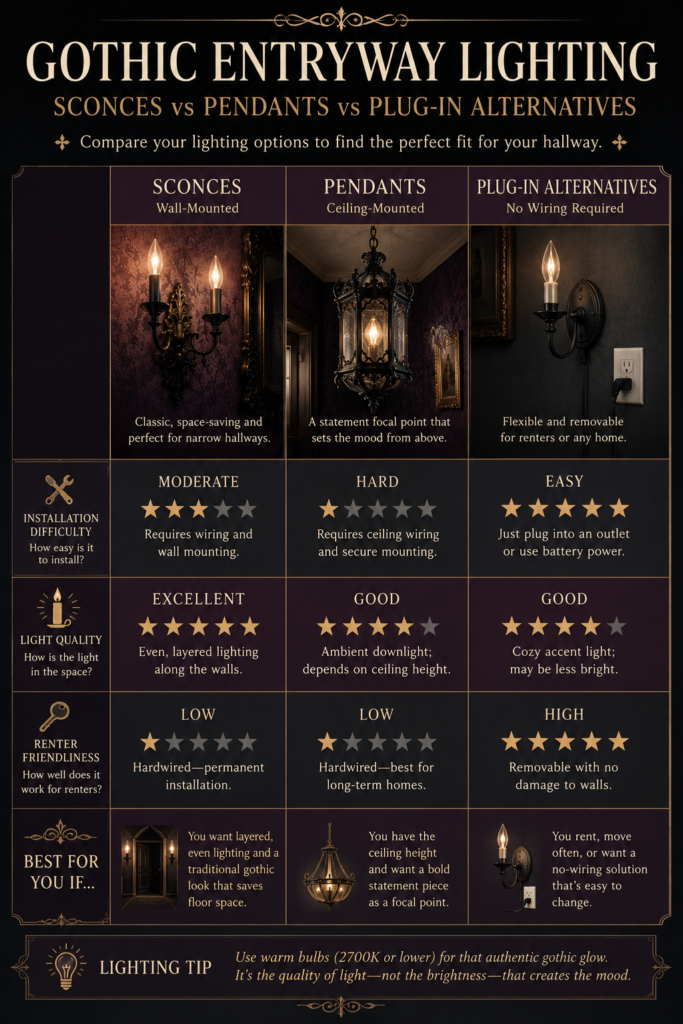
An entryway has jobs to do, somewhere for keys, somewhere for coats, somewhere to check your reflection before you leave the house, and gothic decor works best here when it dresses up function rather than fighting it.
A console table is the natural anchor for a hallway with even a little width to spare. Look for dark, ornately carved wood, mahogany or a black-stained finish, with turned legs or claw feet. It gives you surface space for a lamp, a dish for keys, or a small vignette of candlesticks and botanicals, and it establishes the room’s material palette in one piece.
A coat rack or wall-mounted hooks matter more in a hallway than almost anywhere else in the house, because an entryway with coats piled on a chair stops being gothic and starts being cluttered, however good the wallpaper is. An ornate wrought-iron coat rack or a set of antique-style brass hooks does double duty as both storage and decor.
An umbrella stand is a small, often overlooked piece that earns its keep in a functional hallway. A ceramic or metal stand with an aged or ornamental finish keeps umbrellas and walking sticks from becoming visual clutter by the door.
A mirror, ideally an ornate, gilt-framed or black-framed piece, is close to essential in a narrow hallway for the practical reason that mirrors bounce light and make a tight space read as wider than it is. It’s also doing double gothic duty, since an aged or Victorian-style frame is one of the most efficient single objects for establishing the aesthetic without a full room’s worth of styling. Position it to catch and reflect whatever light source you’ve chosen for the space, sconce or pendant, so it’s actively working the room rather than just hanging in it.
🖤 Wall Treatments That Work in a Narrow Space
Dark walls in a small hallway sound like a contradiction, and handled badly, they can be. Handled well, dark walls in a narrow hallway don’t shrink the space, they remove the visual seams between wall and shadow, which paradoxically makes a tight hallway feel more intentional and less cramped than a poorly lit pale one.
Deep, saturated colours, aubergine, deep forest green, near-black charcoal, work better here than true flat black, which can read as cave-like without careful lighting to offset it. A colour with some depth and undertone gives the eye something to read even in low light, where flat black just goes dark.
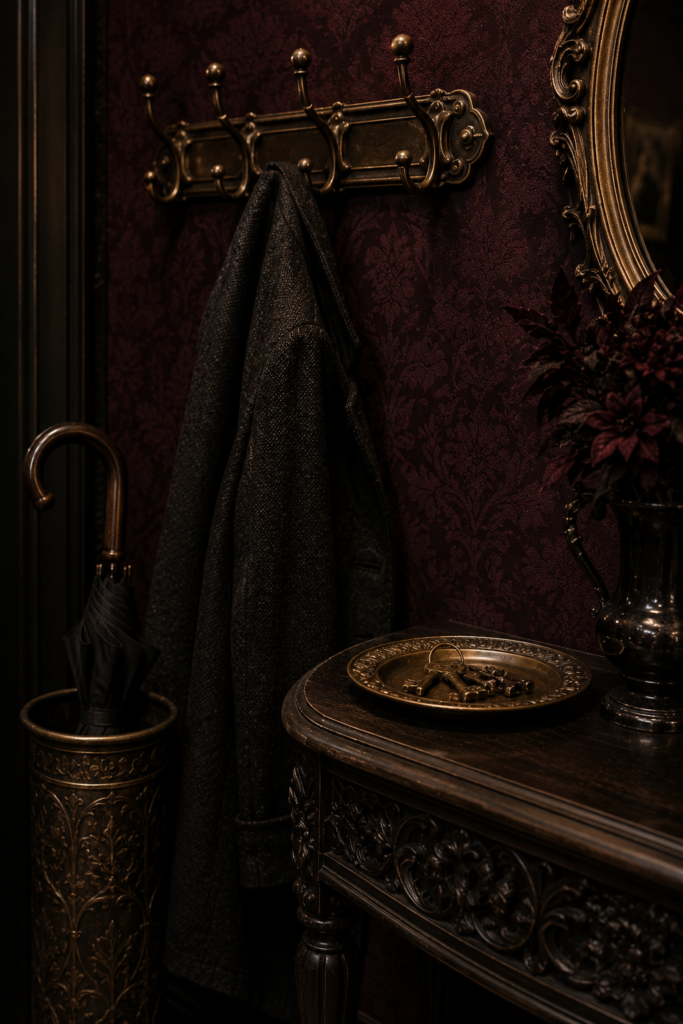
Wallpaper is where a gothic hallway earns its reputation. Damask prints, botanical patterns (particularly anything with a night-blooming or overgrown quality), and Victorian-inspired designs all suit the transitional, slightly theatrical nature of an entryway in a way that might feel like too much in a room you sit in all day. A hallway is walked through, not lived in, which makes it the ideal place in the house to be bold with pattern.
A gallery wall down the length of a hallway solves two problems at once: it fills what’s often an awkward stretch of blank wall, and it gives you a way to layer in the darker, more collected gothic aesthetic (antique-style frames, botanical prints, mirrors of varying shapes) without committing to wallpaper. It’s also the easiest of all these options to do without touching the walls structurally, using picture rail hooks or removable adhesive strips.
For renters, peel-and-stick wallpaper has reached a genuinely good standard in damask and botanical prints specifically, and it goes up and comes down without deposit-risking damage. A single feature wall, rather than the whole hallway, is usually the better move both for cost and for commitment level, whether you’re renting or not.
🧣 Practical Layering That Stays Functional
The details that finish a gothic hallway are the same details that make it work day to day, which is what separates decor that lasts from decor that gets abandoned the first time someone trips over it.
A runner rug down the length of the hallway adds warmth, softens footsteps, and gives you another surface to bring in pattern and texture, damask, Persian-inspired, or a deep solid in velvet-look fibre. In a high-traffic space, choose a low-pile option that won’t show wear within a season.
Curtains or portieres, heavy fabric panels hung in doorways rather than windows, are a genuinely underused gothic device outside period homes. Hung at a doorway leading off the hallway, a portiere adds drama, muffles sound between rooms, and gives you a layer of rich fabric (velvet is the classic choice) without touching a single wall.
Hooks and small storage, the unglamorous end of this list, are what keep a beautifully styled hallway from sliding back into a dumping ground within a fortnight. Build the practical storage in from the start rather than styling around it and hoping it holds.
A vignette looks intentional. A vignette with someone’s gym bag shoved behind it looks like a room nobody planned for.
🏚️ Renter-Friendly Swaps Alongside Full-Reno Options
Every element above has a version that works without permanent changes to the property, and it’s worth being explicit about which is which so nobody rules out a gothic entryway because they don’t own their walls.

Full control (own the space): paint the walls a deep saturated colour, hardwire sconces, hang a wallpaper of your choice, install a fixed console table or built-in coat storage.
Renting or not ready to commit: peel-and-stick wallpaper on a single feature wall, plug-in sconces on existing outlets, a freestanding console table rather than anything wall-mounted, command-strip-hung mirrors and gallery frames, and a runner rug that travels with you at the end of the tenancy.
The aesthetic outcome, done well, doesn’t actually look different between the two lists. The difference is entirely in the mechanism, not the result, which is the point.
📌 The Short Answer
A gothic entryway works when it treats lighting, furniture and wall treatment as solutions to a narrow, low-light, high-traffic space rather than a shrunk-down living room plan. Warm-toned sconces or plug-in alternatives for light, a dark ornately carved console with a gilt or black-framed mirror for function and reflected light, deep saturated colour or damask wallpaper on the walls, and a runner rug plus proper coat storage to keep it liveable. Every one of these has a renter-friendly version that reaches the same result without touching a lease agreement.