
There’s something about a deeply pigmented lip that changes everything. The right dark shade can make pale skin look porcelain-perfect, give warm skin tones a rich, jewelled quality, and turn even the simplest outfit into something deliberately dramatic. Gothic lip colour is one of the most powerful tools in the dark beauty arsenal — and yet it’s also one of the most misunderstood.
As an Amazon Associate I earn from qualifying purchases and sometimes recommend products from other sellers at no extra cost you. For more details see my disclosure policy and privacy policy. Posts may contain AI generated images to illustrate the content.
Dark berry, black, and burgundy might all live in the same shadowy neighbourhood, but they’re actually quite different in what they project, how they wear, and who they flatter. This guide breaks down all three — how to choose between them, how to apply them properly, and how to balance the rest of your makeup so the whole look feels intentional rather than accidental.
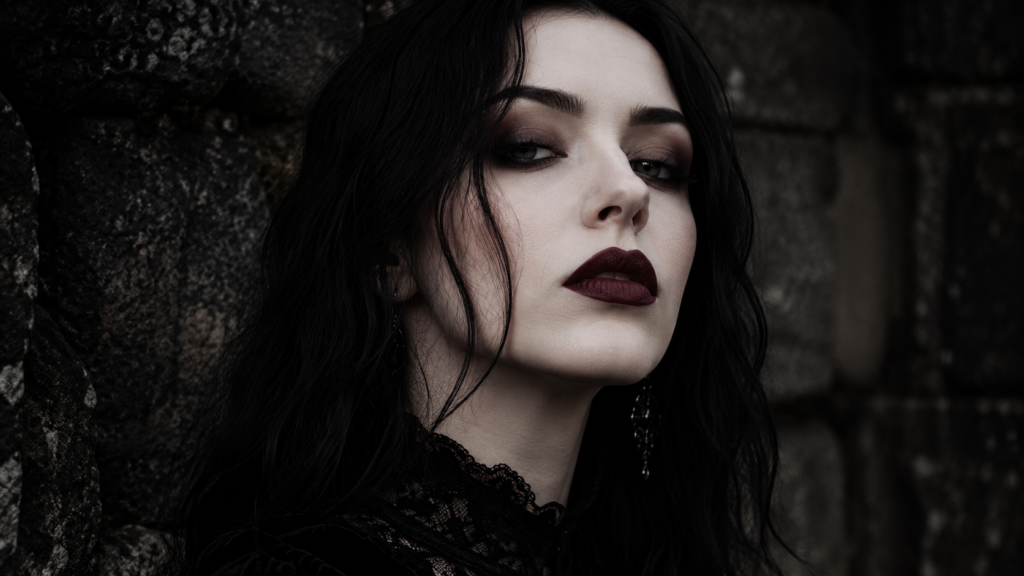
Choosing Your Goth Shade
Before you reach for a lipstick, it’s worth thinking about what you actually want your lips to do in a look. Each of these three shades creates a completely different mood, and understanding that will help you pick with confidence rather than impulse.
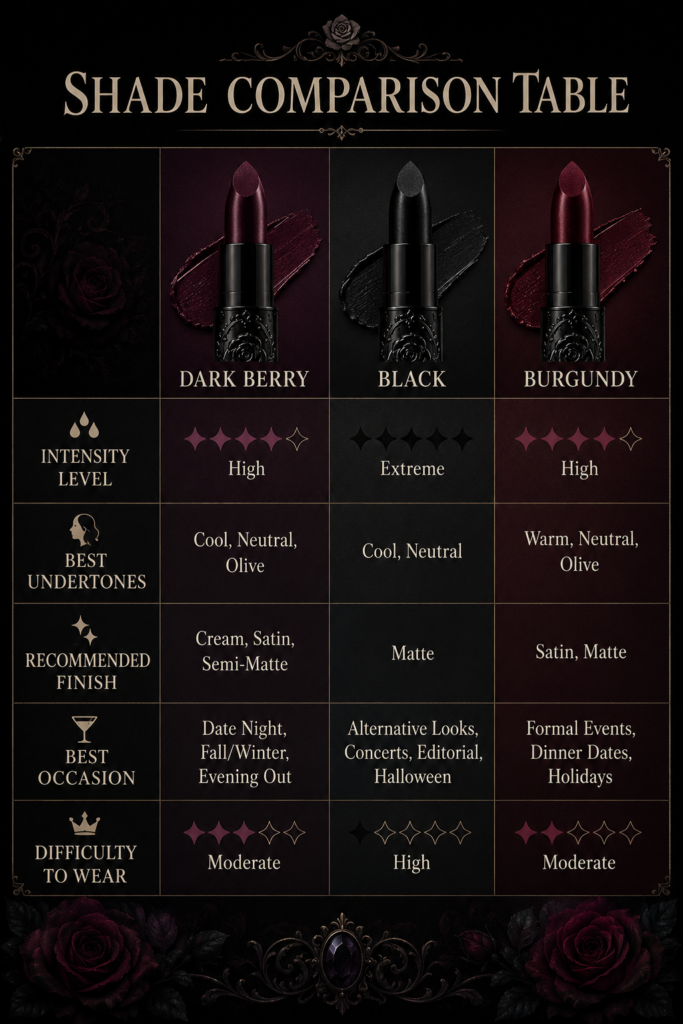
Dark Berry: The Entry-Level Goth Lip
Dark berry is where a lot of people begin their gothic lip journey, and for good reason. It’s dramatic without being confrontational — you get the vampy, vintage feel of a deep wine or plum tone without the full commitment of opaque black. It reads as dark and intentional, but there’s an underlying warmth and romance to it that makes it easier to wear across different occasions.
Midnight Decor
3D printed gothic pieces
Darkly beautiful objects for the gothic home — printed fresh when you order. Each piece is conjured for your space and entirely yours.


Think of shades like deep plum, mulberry, dark mauve, and wine-tinged berry. These are the tones that work beautifully for everyday gothic dressing, evening looks, and anyone who wants impact without going full theatrical. If you’re new to wearing dark lipstick, berry is an excellent starting point — it’s forgiving, flattering on a wide range of skin tones, and works with both heavier and lighter eye looks.
Burgundy: Dark Romanticism in Lipstick Form
Burgundy sits between berry and true black on the darkness spectrum, bringing warmth and depth in equal measure. Deep red, wine, and burgundy tones carry that dark-romantic quality — intense and moody, but still recognisably “red” at their core. If you want drama but don’t want to lose all warmth from your face, this is your shade.
Burgundy tends to feel the most seasonally versatile of the three. It has an obvious home in autumn and winter looks but also works through spring when you want something with more depth than a classic red. It’s the lip colour equivalent of a worn velvet jacket — rich, textured, and unapologetically dark.
Black: Maximum Drama, Maximum Impact
Black is the definitive gothic lip. It reads instantly as dark aesthetic dressing, it pairs effortlessly with almost any colour because black is neutral, and it has a visual intensity that nothing else quite matches. It also requires the most confidence to wear well — not because it’s inherently difficult, but because it’s a strong choice that draws attention.
The most important thing to know about wearing black lipstick is that you rarely want a truly opaque, flat jet black. Most experienced goth wearers reach for off-black or sheer black formulas instead, which avoid the “marker pen” effect and make touch-ups throughout the day far easier. A slightly sheered-out black has depth and sophistication that a solid block of colour often lacks.
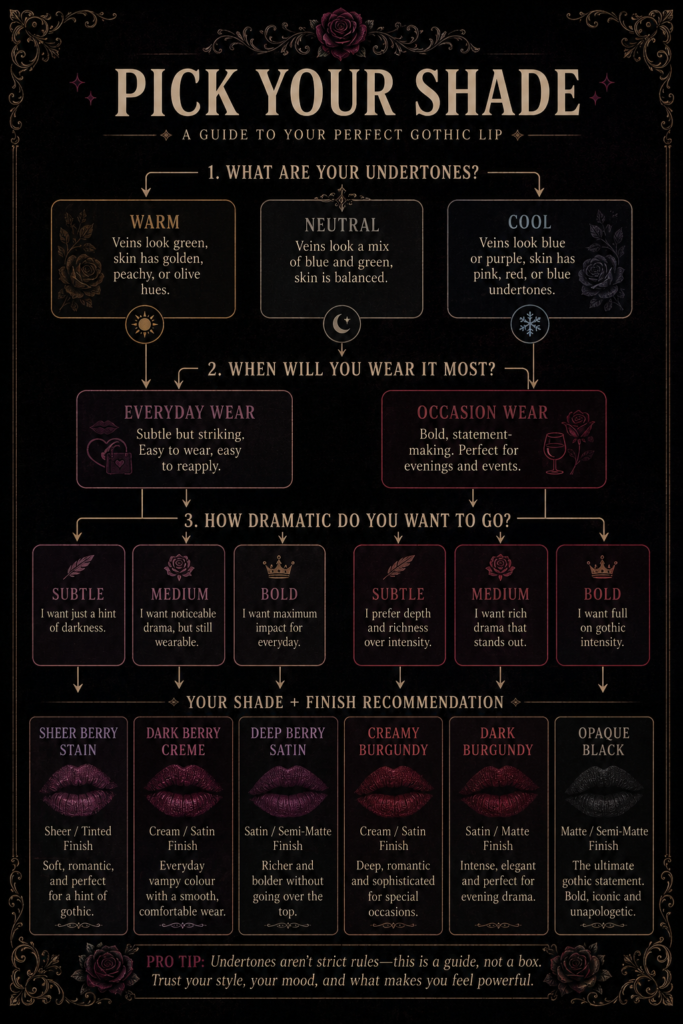
Matching Dark Lipstick to Your Undertone
Here’s the thing that makes the difference between a dark lip that looks stunning and one that looks draining: undertones. Your skin’s undertone affects how a lipstick pigment reads against it, and getting this right elevates the whole look.
Finding Your Undertone
The wrist vein test is the easiest starting point. Look at the veins on the inside of your wrist in natural light. Green veins suggest warm undertones, blue or purple veins suggest cool undertones, and a mix of both indicates neutral undertones. Most people fall somewhere in the middle, which is good news for dark lip wearers — it means there’s a wide range that will work for you.
Warm, Cool, and Neutral Guidance
If you have warm undertones, you’ll generally find that deep berries and burgundies with a blue or cool base work best, brightening the face rather than making it look muddy. Shades with too much warmth can clash with golden or peachy skin tones and push the whole look towards orange — a direction you almost certainly don’t want.
For cool undertones, lean towards shades with more red in them — think oxblood, wine, and plum. These keep the look balanced rather than harsh. Pure black works very well with cool undertones because there’s no colour temperature conflict, which is part of why it tends to suit fair, cool-toned skin so beautifully.
Neutral undertones have the most flexibility. You can genuinely rotate between all three families — dark berry one day, black the next, burgundy the weekend after — and shift depending on your outfit, mood, and how dramatically you want to land.
A Note on Deeper Skin Tones
For deeper skin tones, rich pigmentation is where dark lips really sing. Berry reds, mulberry, and deep burgundy show up with vivid intensity and complement the natural depth of the complexion in a way that lighter shades simply can’t. Black also works beautifully on deeper skin and has a graphic quality that’s particularly striking. The key is to look for formulas with strong pigmentation rather than sheer versions, which can appear washed out or ashy.
Application Techniques for Dark Goth Lips
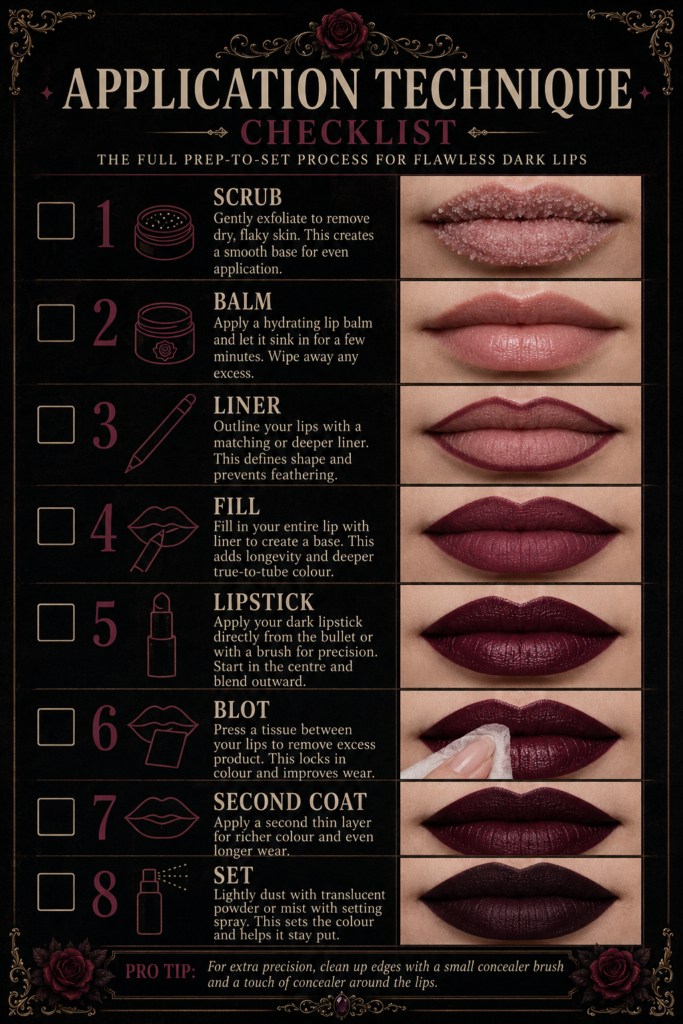
Dark lipstick is less forgiving of sloppy application than lighter shades — any unevenness, feathering, or patchiness is immediately visible. The good news is that getting a clean, long-lasting result is completely achievable with the right prep and technique.
Prep Your Lips First
Dark pigments settle into texture, so smooth lips are non-negotiable. Start with a gentle lip scrub to exfoliate any dry patches, then apply a thin layer of lip balm. The important step most people skip: blot off any excess balm before you start with colour. A greasy base causes lipstick to slide around and shorten wear time significantly.
If your lips tend to be very dry, this prep routine matters even more. A smooth canvas is the foundation of a clean dark lip.
Line, Fill, and Layer
A matching lip liner — or even a black liner for the most dramatic looks — is your best friend with dark lipstick. It defines the edge of your lip, prevents feathering (where pigment bleeds into the fine lines around your mouth), and creates a clean border that makes the colour look deliberate.
For maximum staying power, don’t just line around the edge — fill the entire lip with pencil before applying your lipstick on top. This gives the pigment something to grip and extends how long the colour lasts through eating, drinking, and talking. Once your liner base is down, apply your lipstick in one clean layer, blot with a tissue, then apply a second layer and optionally set with a very light dusting of translucent powder to reduce transfer.
Sheer vs. Opaque: Knowing Which to Reach For
Not every dark lip moment requires full opacity. Sheer black or berry formulas give you the colour impression without total coverage — they’re excellent for beginners who want to experiment, or for daytime looks where you want suggestion rather than statement. A creamy, buildable burgundy sits in the middle ground, giving you control over intensity depending on how many layers you apply.
Full opaque coverage is reserved for when you genuinely want maximum drama. Even then, a matte finish will look different to a satin or gloss — matte reads more stark and editorial, while satin adds a lit-from-within quality that’s slightly more romantic.
Balancing the Rest of Your Makeup
A dark lip is a focal point by design. The rest of your face needs to be planned around it, not applied on top of it as an afterthought.
The Classic Goth Approach: Lips First, Then Eyes
The most common approach in gothic makeup is to let the lip be the star and keep the eyes relatively controlled. This doesn’t mean your eye makeup has to be minimal — a softly smudged liner, a wash of dark shadow, and well-defined lashes all work beautifully alongside a dark lip. What you want to avoid is competing intensities, where both the eyes and the lips are fighting for the same level of attention.
For a classic look, pair your dark berry or black lip with eyes that have atmosphere rather than drama. Think blended shadow, a smudged liner rather than a sharp wing, and mascara rather than a full smoky eye. The result feels intentionally gothic without looking chaotic.
Gothic Glam: When You Want to Go All In
If you’re building a more maximalist look — full goth glam rather than gothic everyday — the approach shifts slightly. Rather than toning down the eyes to balance the lip, you’re aiming for cohesion between both. Picking up a dark berry tone in your eyeshadow or inner corner detail when wearing black lips ties the face together and prevents it from looking flat. The key word is cohesion: the eye and lip should feel like they belong to the same look rather than existing in opposition.
The Modern Editorial Take
There’s also a third approach that’s increasingly popular — and it’s the one that tends to appeal to gothic-adjacent or dark-curious people who don’t want a full goth aesthetic. Keep the skin clean, fresh, and relatively minimal, skip heavy contouring, and let the lip do all the work. A clean base plus a truly dark lip reads as modern, editorial, and deliberately stylish rather than dramatically costumed. It’s a more versatile way to wear gothic beauty that translates easily from day to evening without any touch-up drama.
Building Your Intensity: A Shade Progression for Every Level
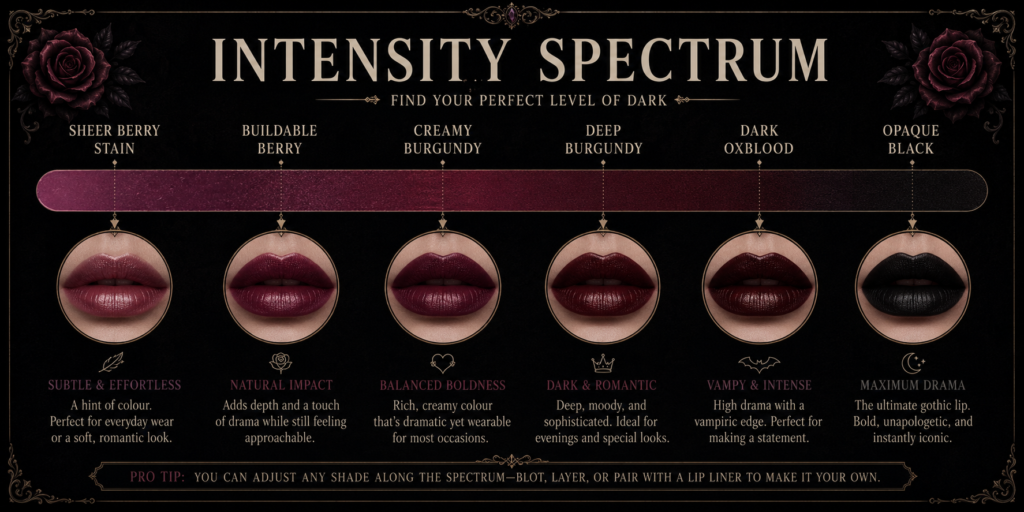
One of the most useful ways to think about gothic lip colour is as a spectrum of intensity, which you can move along depending on your confidence, the occasion, and how much of a statement you want to make.
Beginning: Sheer Berry Stains
A sheer berry stain is gothic beauty at its most approachable. The colour impression is dark and moody but the formula is forgiving — easy to apply, easy to touch up, and wearable in contexts where full opacity would feel too strong. This is an excellent starting point if you’ve always wanted to try dark lips but felt nervous about commitment. You can wear a sheer berry to work, to a casual dinner, or as your everyday lip and still feel like yourself.
Intermediate: Creamy Burgundy
A creamy, buildable burgundy in a satin or soft matte formula is where the look starts to feel more distinctly gothic. It’s rich enough to make an impression, versatile enough to work with most gothic and dark-romantic outfits, and forgiving enough that application doesn’t need to be forensically precise. This is the sweet spot for most gothic beauty enthusiasts — dark enough to feel meaningful, not so extreme that it demands total planning around it.
Advanced: Opaque Black and Near-Black
Full opaque black or an almost-black shade (deep plum-black, blackened burgundy) is for when you want to go all the way. This end of the spectrum is the most dramatic, the most unambiguously gothic, and the most high-maintenance to wear well. The prep, liner work, and layering techniques covered earlier in this guide become even more important here. When it’s done well, though, it’s genuinely extraordinary — there’s no other makeup look quite like it.
What to Know About Finishes
Shade aside, the finish of your lipstick changes the whole quality of a dark lip. Matte finishes are the most editorial and the most intensely pigmented — they don’t move once they’re set, which is a practical advantage, but they can also emphasise dry texture on lips that aren’t well prepped. If you’re wearing matte, your prep routine matters more than ever.
Satin finishes have a soft sheen that diffuses light and gives the lips a fuller, more dimensional look. They’re slightly more comfortable to wear and forgiving of minor texture imperfections. Many people find them the most wearable finish for everyday gothic looks.
Gloss over dark lipstick creates a wet, almost otherworldly effect that photographs beautifully and adds a striking element to dramatic evening looks. A clear or very dark tinted gloss over burgundy or black lipstick is a look worth experimenting with — it changes the energy of the shade completely.
Caring for Your Lips Year-Round
Dark lipstick is only as good as the lips underneath it. A consistent lip care routine makes a significant difference to how well your lipstick applies and wears. A gentle exfoliation once or twice a week removes flaky skin, a nourishing balm worn overnight keeps lips soft, and keeping hydrated generally helps too — lips are one of the first places to show the effects of dehydration.
In winter especially, lips can become very dry and cracked, which makes dark lipstick application frustrating. Investing a little time in lip care as part of your wider gothic skincare routine will pay dividends every time you reach for a dark shade.
Putting It All Together
Gothic lip colour is one of the most iconic and distinctive elements of dark beauty, and dark berry, black, and burgundy are the three shades at the centre of it. Berry gives you romance and approachability. Burgundy gives you warmth and depth. Black gives you full dramatic commitment. Used correctly — with the right undertone matching, solid prep, and a balanced eye look — any of the three can be genuinely transformative.
The best starting point is always to pick the shade that reflects how you want to feel rather than what you think you “should” wear. Gothic beauty is, at its heart, about intentionality — wearing what resonates, wearing it well, and making it your own.
If you’re still building out your dark beauty skills, the Gothic Beauty Routine for Beginners: Your Step-by-Step Guide to Dramatic Dark Beauty is a brilliant companion to this guide. And if you want to explore what you’re working with product-wise, take a look at 5 Gothic Beauty Must-Haves for a Dramatic Look — it covers the essential products that underpin the whole aesthetic.
Continue Your Journey
- Gothic Beauty Routine for Beginners: Your Step-by-Step Guide to Dramatic Dark Beauty — Start here if you’re building your gothic beauty practice from the ground up.
- Dark Romantic Makeup Looks: Beyond Basic Black — Explore how to pair dark lips with softer, more romantic overall looks.
- The Ultimate Guide to Black Eyeshadows for Gothic Makeup — Everything you need to know about completing the eye half of your dark look.
- Unveil Your Inner Darkness: A Guide to Vampire Goth Makeup — For when you want to take the dark lip into full vampire territory.
- Gothic Skincare Routine: How to Care for Pale Skin and Keep That Ethereal Glow — The skin prep that makes dark makeup land better.
Which of the three shades are you most drawn to — dark berry, burgundy, or black? And do you match your lip intensity to your eye look, or do you pick one focal point and keep the other minimal? Let us know in the comments.
Love gothic beauty content? Subscribe to The Gothic World newsletter for dark inspiration delivered straight to your inbox.


