
Rings get the drama and necklaces get the attention, but bracelets and cuffs are the wrist-level workhorses of a gothic wardrobe. They stack, they layer, and they survive a full day of typing, gesturing and general living in a way that some statement pieces simply cannot. This guide walks through the core styles, the materials worth your money, and how to wear and care for them without turning your wrist into an accidental science experiment. Whether you want one serious statement cuff or a whole stacked wrist of smaller pieces, the same handful of decisions applies.
As an Amazon Associate I earn from qualifying purchases and sometimes recommend products from other sellers at no extra cost you. For more details see my disclosure policy and privacy policy. Posts may contain AI generated images to illustrate the content.
🦇 The Core Bracelet and Cuff Styles
Every gothic wardrobe tends to gravitate toward a handful of shapes. Knowing what each one does for an outfit makes shopping far less overwhelming.
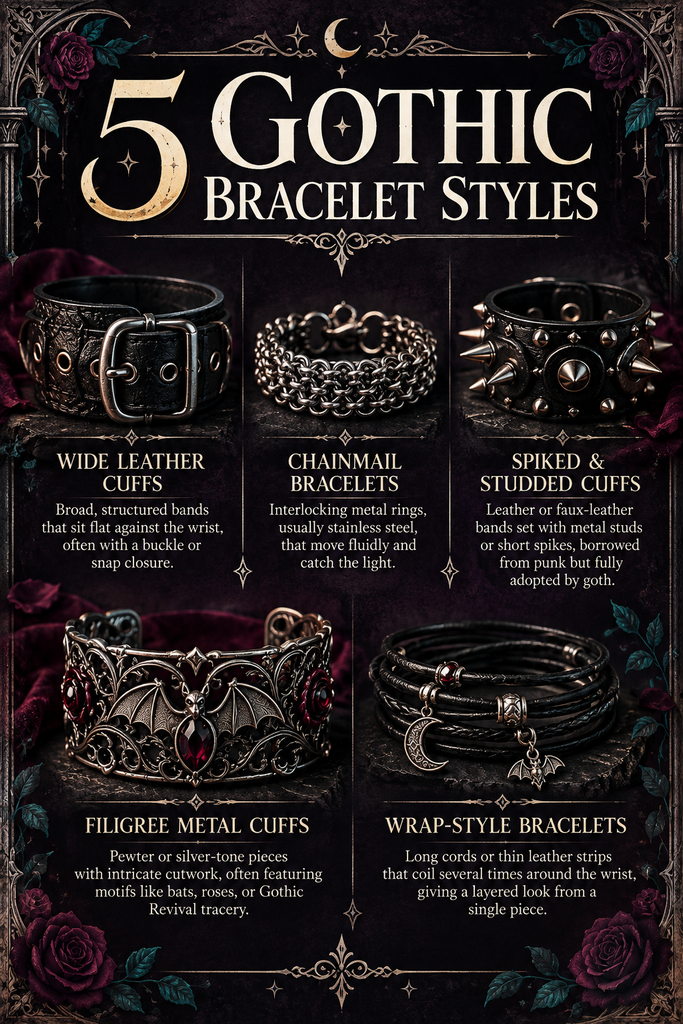
- Wide leather cuffs: broad, structured bands that sit flat against the wrist, often with a buckle or snap closure. These read as the most classically “gothic” of the bunch and anchor a look instantly.
- Chainmail bracelets: interlocking metal rings, usually stainless steel, that move fluidly and catch light without shouting for attention.
- Spiked and studded cuffs: leather or faux-leather bands set with metal studs or short spikes, borrowed from punk but fully adopted by goth.
- Filigree metal cuffs: pewter or silver-tone pieces with intricate cutwork, often featuring motifs like bats, roses, or Gothic Revival tracery.
- Wrap-style bracelets: long cords or thin leather strips that coil several times around the wrist, giving a layered look from a single piece.
None of these is more “correct” than another. A wide leather cuff and a delicate filigree wrap can live in the same jewellery box and get worn on entirely different days, depending on mood and outfit.
Think of the five styles as sitting on a scale from quiet to loud. Wrap-style cords and slim filigree bands sit at the quiet end, easy to wear under a cardigan sleeve without comment. Wide leather cuffs and heavily studded pieces sit at the loud end, built to be noticed rather than hidden. Chainmail bracelets tend to land in the middle, substantial enough to register but fluid enough not to dominate.
Midnight Decor
3D printed gothic pieces
Darkly beautiful objects for the gothic home — printed fresh when you order. Each piece is conjured for your space and entirely yours.


If you already collect gothic rings, you will notice a lot of crossover in finish and motif. Buying a bracelet that echoes a ring you already wear is an easy way to make separate purchases look intentional together.
🕸️ Materials and Craftsmanship
The material dictates everything from price to how a piece ages, so it is worth understanding what you are actually buying.
Leather is the classic choice for cuffs, prized for the way it softens and moulds to the wrist over time. Full-grain leather costs more but wears better; bonded or “genuine leather” (a lower grade, despite the name) tends to crack sooner.
Stainless steel dominates the chainmail and chain-bracelet category. It resists rust and daily wear extremely well, which makes it a sound choice for something you intend to wear constantly rather than save for occasions.
Pewter shows up most often in filigree and cast-detail cuffs, since it takes fine moulded detail beautifully. It is softer than steel, so it dents more easily and needs slightly gentler handling.
Vegan and faux-leather alternatives have improved considerably. Modern polyurethane and cork-based leathers hold structure well for cuffs and rarely crack the way early faux leather did, though they generally will not develop the same rich patina as genuine hide over years of wear.
When comparing two similar-looking pieces, check the closure hardware as closely as the main material. A cuff with a flimsy snap will fail long before the leather or metal does.
Choosing between them often comes down to lifestyle rather than looks. If you work somewhere with strict dress expectations or handle a lot of paperwork and typing, stainless steel chainmail tends to survive daily friction better than leather, which can pick up marks from desks and bag straps. If your day involves less physical wear and tear, a leather cuff or pewter filigree piece gets more chance to show off its detail without picking up scuffs. Neither choice is a downgrade; they simply suit different days.
🦇 Styling and Stacking With Your Outfit
Bracelets and cuffs are the easiest gothic accessory to build up gradually, piece by piece, because stacking is genuinely encouraged rather than tolerated.
- Mix textures, not just metals. Pair a matte leather cuff with one or two slim polished chain bracelets rather than reaching for three of the same finish.
- Let one piece lead. If you are wearing a wide statement cuff, keep everything else on that wrist minimal, then stack more freely on the other side.
- Match metal tones to your existing pieces. If your gothic earrings are silver-tone, keep bracelet hardware silver-tone too, unless you are deliberately going for a mixed-metal look.
- Consider sleeve length before buying width. A very wide cuff can look wonderful under a fitted sleeve and completely disappear under a bulky one.
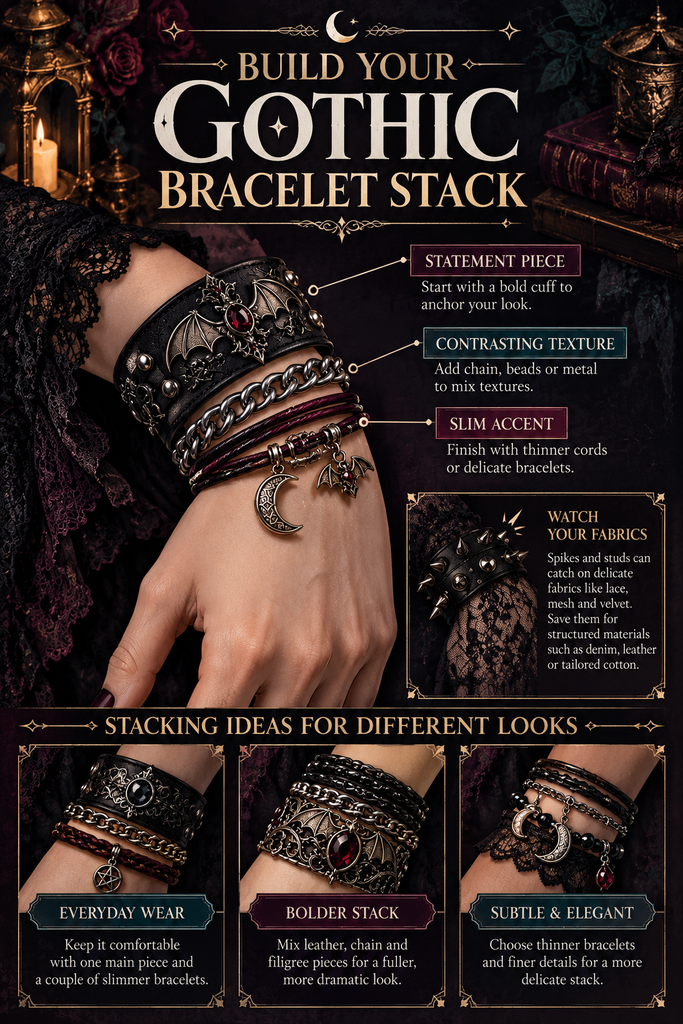
Stacking is also where budget pieces earn their keep. A handful of inexpensive thin bangles or cords can fill out a stack around one genuinely well-made cuff, so the investment piece does the visual heavy lifting.
Fabric matters too. Velvet and lace sleeves tend to catch on spikes and studs, so save those pieces for structured fabrics like denim, leather, or tailored cotton. Sheer or mesh sleeves, by contrast, let a wrist stack show through and photograph beautifully, which makes them a natural pairing with wrap-style cords.
🌙 Everyday vs Statement-Occasion Picks
Not every bracelet needs to survive a full workday, and not every workday piece needs to hold up under stage lighting.
For everyday wear, look for lower-profile pieces: slim wrap cords, simple stainless steel bands, or a leather cuff without spikes that might snag on sleeves or bags. These should be comfortable enough that you forget you are wearing them by mid-afternoon.
For statement occasions, this is where wider leather cuffs, elaborate filigree, and anything with spikes or heavier chainmail earns its place. A wide adjustable leather cuff is a solid starting point if you only want to own one true statement piece before deciding whether to expand the collection.
A reasonable rule of thumb: if a bracelet limits what you can comfortably do with your hands, keep it for evenings and events rather than daily rotation.
🦇 Care and Maintenance
Cuffs and bracelets take more physical contact than almost any other jewellery category, so a little maintenance goes a long way.
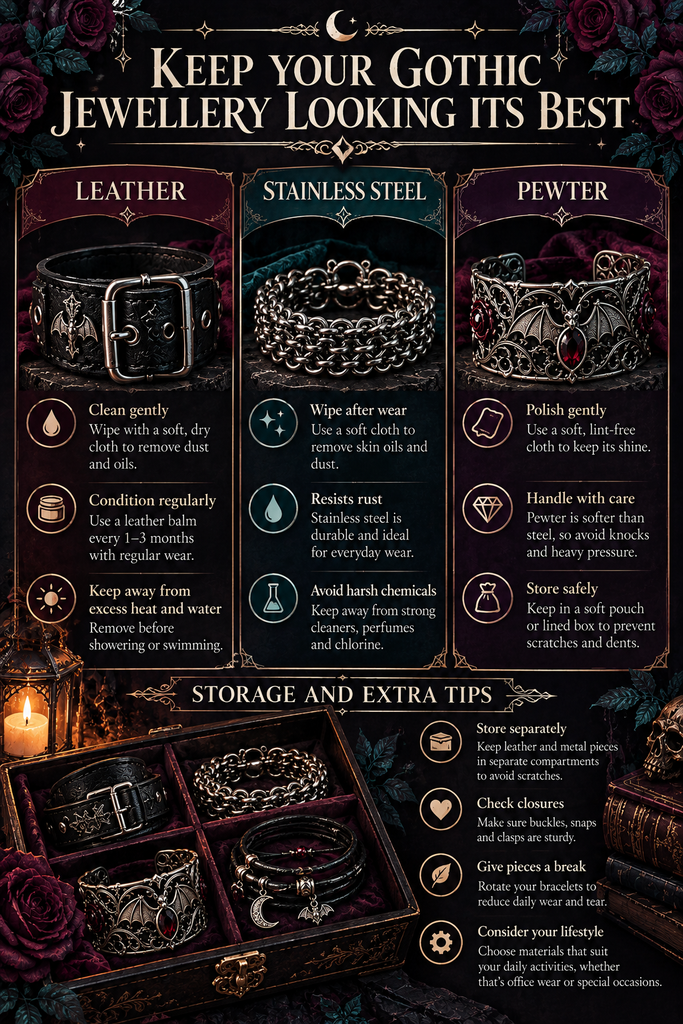
Leather conditioning. Genuine leather cuffs benefit from conditioning roughly every one to three months with regular wear, more often if the leather starts looking dull or feels stiff rather than supple. Over-conditioning can actually saturate and weaken the material, so little and often beats one heavy application. A dedicated leather conditioning balm works better than household oils, which can darken or degrade the surface unevenly.
Metal tarnish prevention. Stainless steel resists tarnish extremely well, but pewter and silver-tone finishes benefit from being stored separately in a lined box or soft pouch rather than tossed loose in a drawer. Removing bracelets before showering, swimming, or applying lotion and perfume limits the chemical exposure that dulls metal finishes fastest. A quick wipe with an anti-tarnish polishing cloth after wear keeps pieces looking newer for longer, and a deeper clean every few weeks prevents buildup from settling in.
General storage. Keep leather and metal pieces apart where possible. Leather can transfer oils or dye onto lighter metals, and some metal cleaners are too harsh for leather if pieces are stored touching.
🕸️ Frequently Asked Questions
How many bracelets is too many for stacking? There is no fixed number, but if pieces are colliding audibly or catching on sleeves, that is the practical ceiling. Three to five pieces per wrist is a common comfortable range.
Can I wear a leather cuff every day? Yes, provided you rotate conditioning as described above. Daily wear actually helps leather develop a nicer patina than occasional wear followed by long storage.
Are vegan leather cuffs as durable as genuine leather? Modern vegan leathers hold up well for structure and shape, though they age differently. They will not develop the same patina, but they also will not need conditioning in the same way genuine leather does.
Do gothic bracelets have to be black? No. Black, oxidised silver, gunmetal, and deep oxblood or plum tones all read as gothic. Colour matters less than the shape, material, and detailing carrying the aesthetic.
What is the actual difference between a cuff and a regular bracelet? A cuff is typically rigid or semi-rigid and opens at one point to slip over the wrist, sitting close to the skin without a clasp. A regular bracelet is usually a closed loop or chain with a clasp, which tends to sit slightly looser and move more freely.
Bracelets and cuffs reward experimentation more than almost any other gothic accessory category. Start with one well-made piece in a material you actually want to maintain, then build the stack outward from there. For the rest of your jewellery box, our Victorian mourning jewelry guide and dark gemstones for statement jewellery posts cover the history and stone-focused pieces that sit outside this guide’s scope.


