
Your brows are doing more work than you might realise. In gothic makeup, they’re not just a framing detail — they’re part of the whole character. A perfectly sharpened, high-arched brow reads as theatrical and intentional in a way that pulls an entire look together, while an undefined or mismatched brow can soften a dramatic look you worked hard to build.
As an Amazon Associate I earn from qualifying purchases and sometimes recommend products from other sellers at no extra cost you. For more details see my disclosure policy and privacy policy. Posts may contain AI generated images to illustrate the content.
The good news is that gothic brow styling isn’t about one rigid aesthetic. There are several distinct approaches that suit different goth subcultures, face shapes, and commitment levels — from a subtle dark-brow enhancement for everyday wear to a fully drawn-on, shaved-and-redrawn trad goth arch that’s practically performance art. This guide covers them all, along with the prep, products, and technique tips that make the difference.
What Makes a Gothic Brow?
If mainstream brow trends are chasing “natural” and “fluffy,” gothic brows go in the opposite direction — or at least, they do on their own terms. Gothic brows are defined by high contrast, intentional shaping, and a deliberate quality that signals you’ve thought carefully about your look. They tend to be darker than the natural hair colour, often sharper than everyday brows, and shaped to enhance drama rather than blend in.
That said, not all gothic brows look the same. The aesthetic varies quite a bit depending on your personal style within the subculture. A trad goth look calls for something very different from a soft goth or alt aesthetic, and a graphic editorial brow is a different project entirely. The starting point for getting your gothic brows right is figuring out which archetype actually fits the looks you want to create — then working backward from that to technique and product.
Midnight Decor
3D printed gothic pieces
Darkly beautiful objects for the gothic home — printed fresh when you order. Each piece is conjured for your space and entirely yours.


Which Gothic Brow Shape Is Right for You?
Answer six questions to find your perfect dark arch
Tips for your archetype
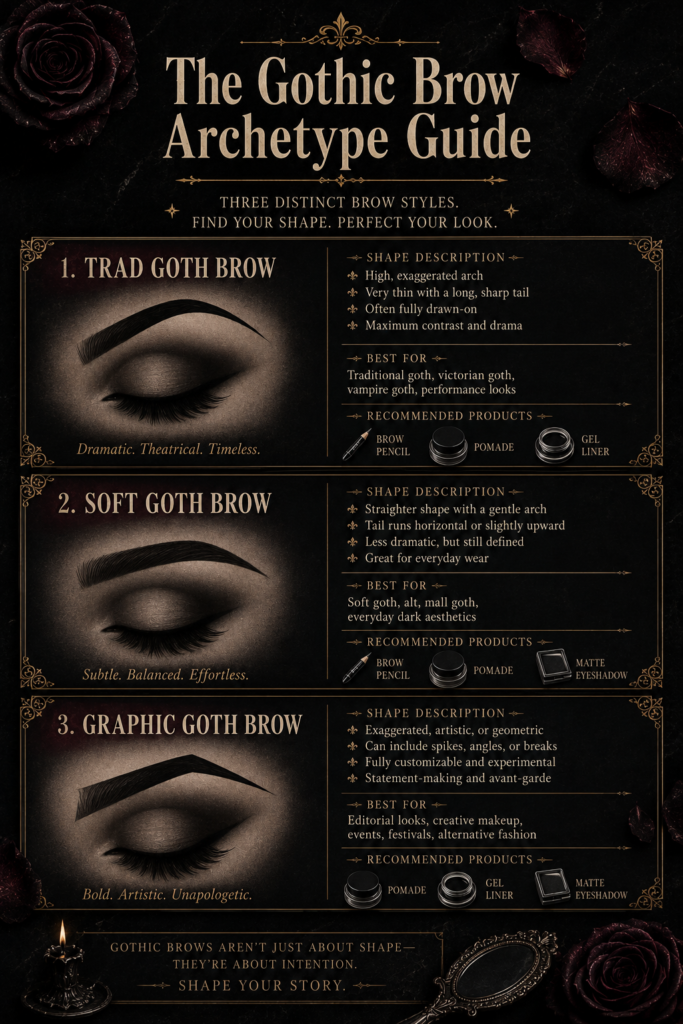
The Three Main Gothic Brow Archetypes
Trad goth brow: This is the classic theatrical arch — thin, high, with a long tail that either angles slightly upward or extends dramatically outward. It’s often fully drawn on rather than depending on natural brow hair, which gives it that stark, heavily stylised quality. Think silent film villain meets Victorian portrait. The contrast between pale or matte base makeup and a sharp dark brow is what makes this shape so striking.
Soft goth / alt / mall goth brow: A straighter shape with less arch, sometimes with the tail running almost horizontally or angling very gently upward. This brow is less theatrical than the trad arch but still darker and more defined than everyday brows. It’s a good option if you want a look that transitions between goth and everyday — the angle of the tail is key here, as a slightly upward tail looks more lifted and intentional than one that drags downward.
Creative / graphic goth brow: This is where things get experimental — triangular shapes, exaggerated spike angles, razor-sharp geometric edges, or even brows that incorporate artistic elements from the rest of the makeup look. These are usually event or editorial looks rather than daily wear, and they rely on combination techniques (pencil, eyeshadow, gel liner) rather than a single product.
Prep and Mapping: The Step Most People Skip
The difference between a gothic brow that looks polished and one that looks patchy or uneven usually comes down to prep. Taking a few minutes before any tweezing, shaving, or drawing is the thing most tutorials skip over, and it shows.
Start by cleansing your skin and brushing your brows upward with a spoolie so you can actually see the natural shape you’re working with. This sounds basic, but it’s easy to overpluck when you’re looking at unbrushed, flattened hairs that disguise the actual line of your brow.
Sketching Before Committing
Before removing any hair, use a brow pencil or matte eyeshadow to sketch the shape you want. Draw the outline first, then step back and look at both brows together in good light. Only tweeze or shave hairs that fall clearly outside that outline. It’s much easier to remove a little more hair than to wait six weeks for it to grow back.
For more dramatic gothic shaping — particularly if you want to remove the tail and redraw it at a steeper angle, or thin the brow significantly — this sketching step is non-negotiable. Spending five minutes drawing your intended shape in makeup before reaching for a razor is how you avoid a result that doesn’t match what you had in your head.
A Simple Brow Mapping Guide
There’s a general framework for brow placement that works as a starting point, even if you’re going to depart from it significantly:
- Front of the brow should start roughly above the inner corner of the eye, and should be softer and slightly less defined than the rest — a hard start to the brow looks blocky
- Arch sits roughly above the point between your outer iris and the outer corner of your eye (for a standard arch), or can be shifted outward for a more dramatic gothic angle
- Tail ends at a point aligned with the outer corner of the eye in mainstream brows — for gothic looks, you can extend the tail further out, angle it upward for a witchy lift, or shorten and redraw it at a steeper angle entirely
Use this as a map, not a rule. Gothic brow styling is meant to be theatrical.
Shaping Techniques for Different Goth Styles
Going Thin: The Trad Arch
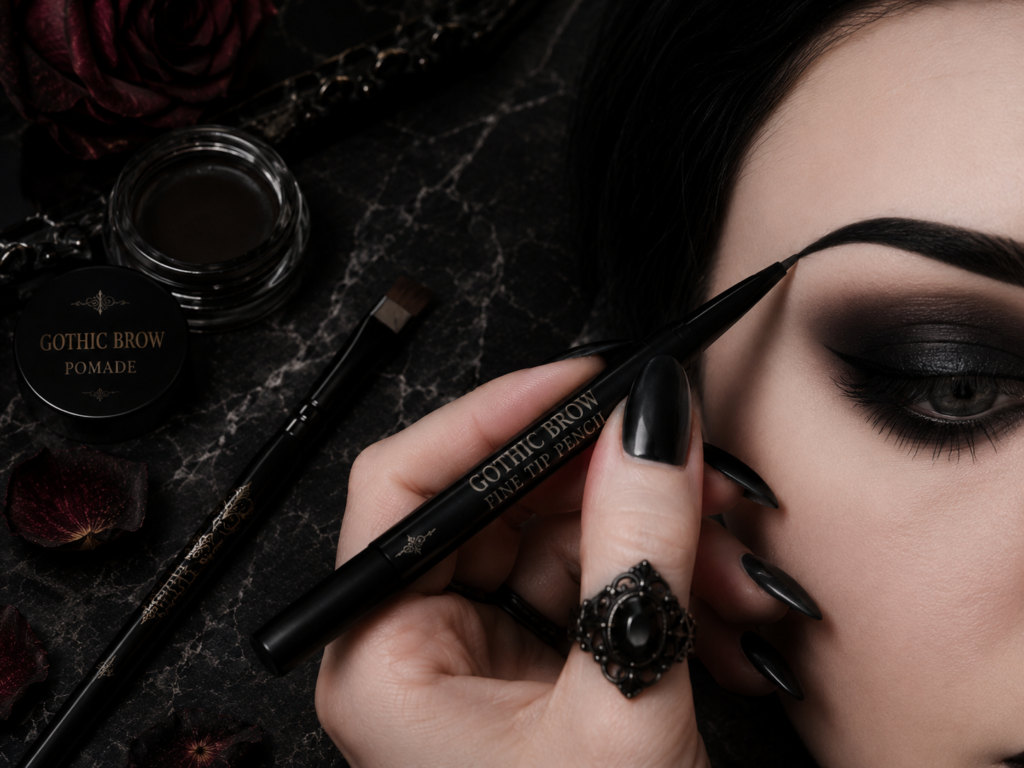
Thinning brows significantly or removing the tail to redraw it is a bigger commitment than filling, so it’s worth thinking through before you do it. If you’re new to gothic brow shaping, start by using makeup to simulate the shape for a few weeks before removing hair permanently (or semi-permanently — hair does grow back, but slowly).
For a classic trad goth brow, you’re typically aiming to thin the lower edge significantly and remove the natural tail to replace it with a drawn-on version at a sharper angle. The front of the brow can be kept slightly fuller, with the arch and tail being the most stylised parts.
Tweezing is the most precise method for removing individual hairs. Shaving with a brow razor gives a clean result quickly and is very popular in the goth community for reshaping — the hair grows back faster than with waxing or threading, which is actually useful when you’re experimenting with shape. If you’re committing to a specific shaved-and-redrawn look long-term, threading with a professional is worth considering for a very clean baseline.
Staying Natural: Enhancing Without Removing
Not every gothic brow look requires hair removal. If you have naturally darker or more defined brows, you might simply need to darken, sharpen, and set them rather than reshape. This is where product technique becomes the focus — how you fill, edge, and finish your brows matters as much as the shape itself.
For soft goth and alt brow aesthetics in particular, working with your natural brow rather than against it tends to produce cleaner results. The goal is to make the brow look more deliberate, not more artificial — a distinction that gets lost when people over-sketch or add too much product.
Products and Application: What Actually Works
What to Use for Drawing and Filling
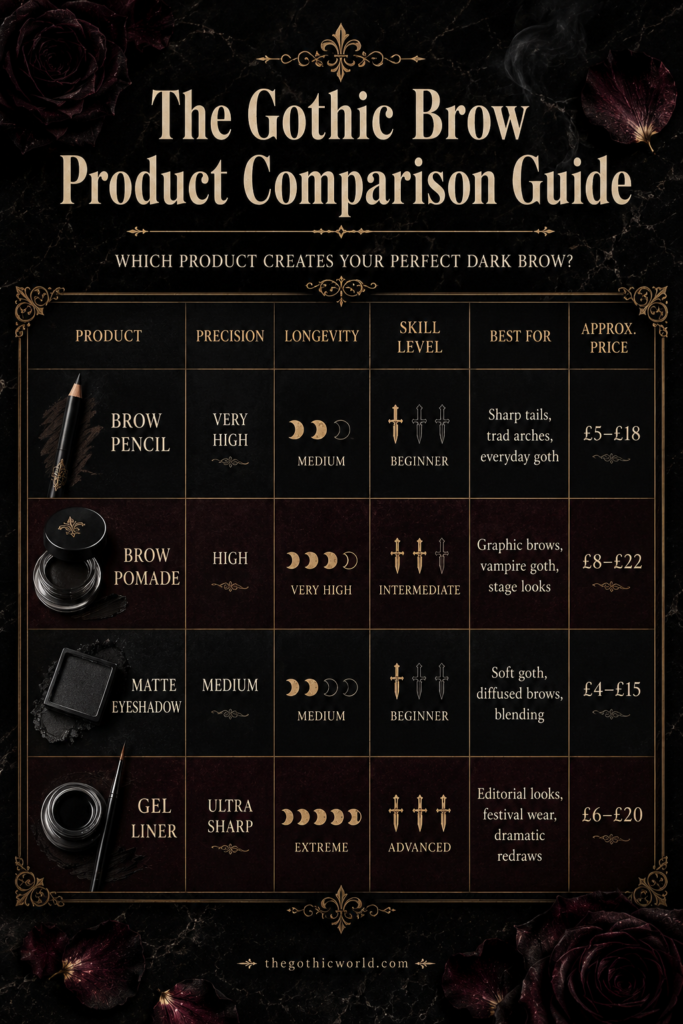
Brow pencil: The most precise tool for drawing individual hair strokes and defining the tail. For gothic aesthetics, go darker than your natural hair — a dark brown or dark grey if you want depth without full black, or straight black for trad and graphic looks. A mechanical pencil with a fine tip gives the most control.
Brow pomade or gel: Excellent for bold, graphic shapes because it delivers intense pigment and holds well. It’s slightly harder to use than pencil for beginners, but gives a longer-wearing result that holds up under stage lights or in hot venues. Apply with an angled brush.
Matte eyeshadow: Useful for filling in and softening the main body of the brow, especially when used alongside pencil or pomade. Dark brown, taupe, or black shadow applied with an angled brush gives a softer, blended quality to the fill while still delivering depth.
Concealer: Often overlooked but extremely useful for gothic brow work — a small flat brush loaded with concealer can be used to carve out crisp edges, sharpen the tail, and clean up any blending. This is how you get that sharp, graphic quality rather than a soft or diffused brow edge.
Application Order: Front to Back, Light to Sharp
The technique that makes the biggest difference is working from the tail inward, rather than starting at the front. Starting at the front leads to over-filling and a blocky inner brow, which is the most common brow mistake regardless of aesthetic.
- Begin with the tail: define the line and angle, then draw the arch
- Fill the body of the brow using lighter pressure, working with any natural hair texture
- Add any final sharpening with pencil or gel at the edges
- Use concealer below and above the tail to carve the shape crisp
- Set with a clear or tinted brow gel, brushing hairs upward and slightly outward
This front-to-back cleanup approach is what gives gothic brows their characteristic precision. It’s not that complicated — it just requires doing the concealer step that most people skip.
Long-Wear Tips for Events and Festivals
For gothic festival fashion or all-day events where you need brows to stay sharp for hours, a few extra steps make a real difference. After drawing and setting your brows, apply a thin layer of clear or coloured brow gel and let it dry fully before touching. If you’ve redrawn a tail on bare skin, sealing it with a long-wear gel liner before cleaning up the edges with concealer gives you significantly more staying power. This is the technique a lot of people in the live music and goth club scene swear by — it holds through sweat, close contact, and long nights in ways that pencil alone simply doesn’t.
Balancing Brows With the Rest of Your Gothic Makeup
One of the things that separates a cohesive gothic look from a muddy one is how the brows interact with everything else happening on the face. The key principle is contrast: you want at least one feature to be clean and sharp enough to anchor the drama elsewhere.
If you’re going for heavy dark eye makeup — a deep smokey eye, thick liner, or dramatic eye shadow — clean, defined brows keep the face from looking dense and heavy. The brows act as structure that frames the eye look rather than competing with it. Trad gothic eyes and a precisely drawn, sharp brow work well together precisely because the brow provides a clear architectural line above the shadow.
Brow Weight and Eye Proportion
For a very thin, sparse trad brow paired with intense eye makeup, keep the brow minimal and linear — the power comes from contrast between the sharp drawn line and the depth of the eye. Adding too much fill to a drawn-on trad brow softens the effect you’re working toward.
For softer goth aesthetics with more blended or wearable eye looks, a slightly fuller brow can balance the overall face without looking too groomed or mainstream. The key is matching the level of definition — if your eye look is more blended, your brow can have softer edges too.
The Role of Base Makeup
Gothic base makeup is often matte and on the cooler or paler side, which changes how brows read on the face. Pale or matte skin makes dark brows pop significantly more than the same brow product would on a warmer, more neutral base. If you’re working with a pale gothic base and dark brows, you may need slightly less product than you think — the contrast does a lot of the work. Start with less and build up rather than applying heavily and having to clean up edges.
This also means that a well-defined dark brow is one of the most effective tools in your gothic makeup kit. Even on days when you’re not doing full eye makeup, darkened and shaped brows alone can anchor the gothic aesthetic in a way that reads intentional rather than half-finished. It’s the kind of thing that makes people ask what you do differently, even when the rest of your makeup is minimal.
Gothic Brows Across Different Subcultures
It’s worth briefly touching on how brow approaches shift across different aesthetics that sit under the gothic umbrella, since there’s a lot of variety even within the subculture.
Victorian goth / elegant goth: Tends toward defined, structured brows — usually a classic arch, darker than natural, with clean edges. More refined than theatrical. Pairs well with deeper lip colours — if you haven’t explored that yet, the Gothic Lip Colour Guide: Dark Berry, Black, and Burgundy is a great companion read.
Vampire goth / dark glamour: Often the most polished of the gothic aesthetics in terms of brow shape — think high arch, sharp tail, and perfect symmetry. The Vampire Goth Makeup guide has more on how this fits into the broader look.
Soft goth / romantic goth: The most relaxed approach to gothic brows — defined and darker than natural, but less architectural. Works well with the kind of blended, wearable gothic eye looks in the Dark Romantic Makeup Looks: Beyond Basic Black post.
Alt / mall goth: Straight brow with minimal arch, often with a very slightly upturned tail. The lack of arch gives a cooler, more detached aesthetic quality. Heavy emphasis on eye makeup and liner makes the brow contrast particularly effective here — the Different Types of Eyeliner guide is useful alongside this.
Creative / graphic looks: Anything goes, and the brow becomes part of the artistic composition rather than just a frame. If you’re working on theatrical or event makeup, thinking of your brows as a design element rather than a beauty step opens up a lot of options.
Getting Started: Where to Begin If You’re New to This
If you’ve never shaped your brows beyond basic maintenance, starting with makeup alone — before any hair removal — is the sensible move. Spend a few weeks experimenting with drawn-on shapes over your natural brow to figure out what style you actually like on your face. Gothic brow aesthetics look very different on different face shapes and brow structures, and what reads as stunning in a reference photo may not be the right angle or arch for your specific features.
Once you’ve landed on a shape you like and have worn it enough to feel confident, then consider whether tweaking the natural hair will help you achieve it more easily. A lot of gothic brow enthusiasts find that minor tweezing — just cleaning up the lower line of the brow and defining the tail area slightly — makes the drawn-on work much easier without requiring a dramatic commitment.
If you’re building your gothic makeup skills more broadly, the Gothic Beauty Routine for Beginners covers how brow work fits into a full dramatic look, and the 5 Gothic Beauty Must-Haves for a Dramatic Look post includes product recommendations that apply directly to brow work as well.
Gothic style is about intention above everything else. Brows that look deliberately shaped — whether that’s sharply architectural or darkly refined — signal the same quality of thought that goes into the rest of a gothic look. You don’t have to shave everything off and start from scratch to get there. You just have to be deliberate.
Continue Your Journey
- Gothic Beauty Routine for Beginners: Your Step-by-Step Guide to Dramatic Dark Beauty — A full walkthrough of building a gothic makeup routine from scratch, including how brows fit into the complete look
- The Ultimate Guide to Black Eyeshadows for Gothic Makeup — Everything you need to know about creating dark, dramatic eye looks that pair with your brow work
- Dark Romantic Makeup Looks: Beyond Basic Black — Softer, more blended gothic makeup aesthetics for those who want drama without going full theatrical
- Gothic Lip Colour Guide: Dark Berry, Black, and Burgundy — How to choose and apply the dark lip shades that complete a gothic makeup look
- Creating a Gothic Vanity Setup: Your Dark Sanctuary for Beauty Rituals — Designing a dedicated beauty space that makes your makeup ritual feel as intentional as the look itself
Which gothic brow archetype are you drawn to — the theatrical trad arch, a cleaner alt brow, or something more experimental? Drop your thoughts in the comments below.
Want more gothic beauty guides, styling tips, and dark aesthetic inspiration delivered straight to your inbox? Subscribe to The Gothic World newsletter and never miss a post.


