
Goth hair isn’t really about one specific cut or colour. It’s about mood — dark, dramatic, and intentional. Whether you’re drawn to the teased, sky-high volume of traditional goth, the soft romantic curls of Victorian-inspired looks, or the grungey, undone texture of alt aesthetics, there’s a version of gothic hair that suits you.
As an Amazon Associate I earn from qualifying purchases and sometimes recommend products from other sellers at no extra cost you. For more details see my disclosure policy and privacy policy. Posts may contain AI generated images to illustrate the content.
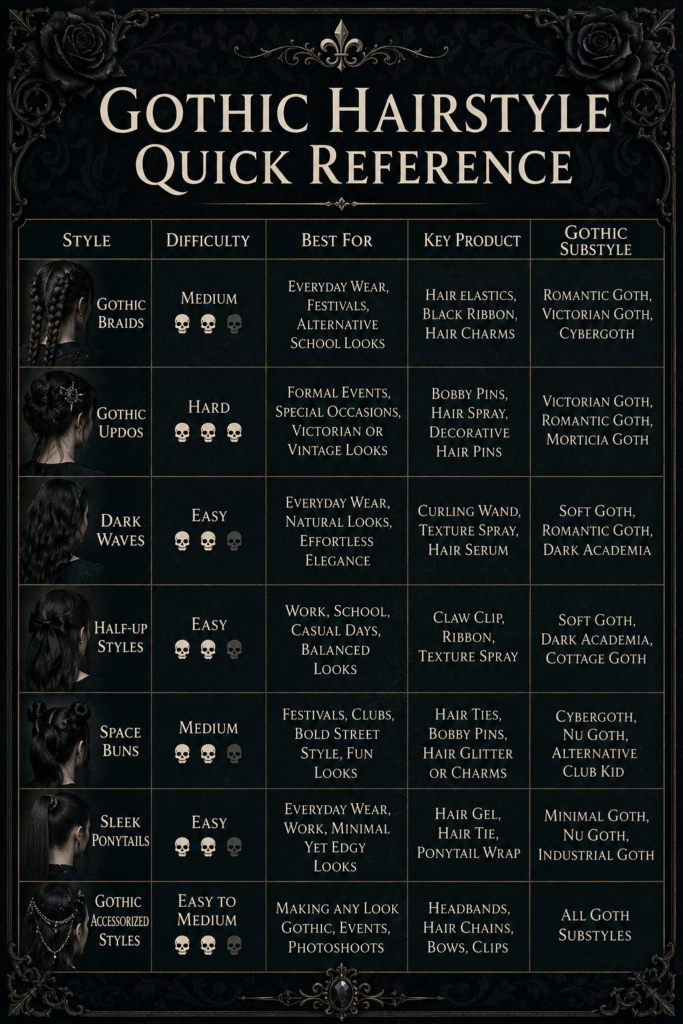
In this guide, we’re covering three of the most versatile categories: gothic braids, vampy updos, and inky dark waves. Each one can be adapted for everything from casual days to events, and none of them require a salon appointment. If you’ve already sorted your gothic beauty routine and gothic brow styling, your hair is the next piece of the aesthetic puzzle — and it’s one of the most expressive.
What Actually Makes a Hairstyle Look Gothic?
Before getting into the specifics, it’s worth understanding what ties all these styles together. The goth aesthetic in hair isn’t accidental — it’s built from a handful of deliberate choices that give any look that signature dark edge.
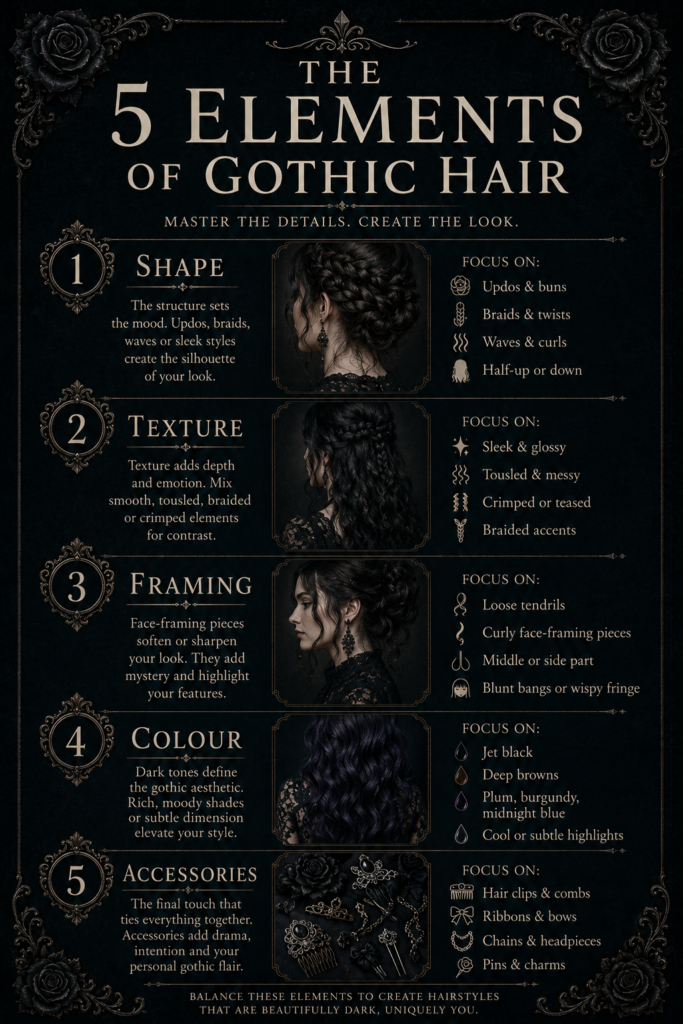
Shape is the starting point. Gothic hair tends to favour volume at the crown, sharp geometric lines, or deliberately messy silhouettes. It leans away from anything that reads as polished and “normal.” Texture matters just as much — think teased roots, piecey ends, soft waves, or crimped strands rather than the smooth, bouncy curls associated with more mainstream styles.
Midnight Decor
3D printed gothic pieces
Darkly beautiful objects for the gothic home — printed fresh when you order. Each piece is conjured for your space and entirely yours.


Framing is another key element. Blunt bangs, micro fringes, V-shaped bangs, or long face-framing pieces draped around the cheekbones all create that mysterious quality that goth hair is known for. And of course, colour does a lot of the heavy lifting: black, blue-black, deep plum, forest green, and split-dye streaks all push a hairstyle firmly into gothic territory even if the actual style is relatively simple.
Finally, accessories can transform an otherwise ordinary style into something unmistakably goth. Think black velvet bows, safety pins woven through braids, chain details, spiderweb clips, lace veils, or ornate crosses. Accessories are especially useful if you can’t or don’t want to dye your hair — they signal the aesthetic clearly without any permanent commitment.
Gothic Hair Style Finder
Answer 4 questions — get your ideal gothic hairstyle.
Styling tips
Section 1: Gothic Braids
Braids are one of the most versatile tools in gothic hairstyling. They can swing from quiet and understated — think Wednesday Addams’ clean double plaits — to something heavily accessorised and deliberately dramatic. The same basic technique produces completely different results depending on how you finish the style.
The Classic Wednesday-Style Double Braid
The double braid is the entry point for most people, and for good reason: it’s achievable, recognisable, and endlessly customisable. Start with a clean centre part, and work two tight, low braids using smooth, even sections. The clean lines give it that severe, intentional quality — this isn’t a messy, casual braid.
To push it into more gothic territory, weave a length of black ribbon through each braid as you plait. Leave a few wispy, untucked pieces around the face to soften the overall effect slightly and create that slightly haunted quality. For darker, grungier interpretations, finish with dark lipstick and smudged liner — the contrast between the neat braids and dramatic makeup is where the magic happens.

Dutch Braids, Corset Details, and Faux-Hawks
If you want something with a bit more architectural drama, Dutch braids open up a lot of options. Because they sit on top of the hair rather than underneath, they create a bolder, more structured silhouette. Try double Dutch braids with a thin cord or chain laced between the sections “corset style” — this creates a genuinely striking detail that photographs beautifully.
A braided faux-hawk is another option worth trying, particularly for those who want something punky and asymmetric. Braid a central strip from forehead to nape, leaving the sides loose and flowing, then decorate the braid itself with safety pins, small silver rings, or spikes. It sits somewhere between traditional braid territory and something distinctly alt.
Messy Fishtail Braids for a Grungier Look
The fishtail braid lends itself naturally to a slightly undone, grungy aesthetic — especially when it’s deliberately imperfect. After you’ve plaited it, gently tug on alternating sections to loosen and widen it, creating that “just slept in it” texture. Paired with black lipstick and smudged eyeliner, it reads as effortlessly dark rather than polished.
For added depth, consider incorporating coloured streaks of deep blue or forest green into your hair before braiding. These details catch the light and create a moody, dimensional effect that works particularly well with the uneven texture of a loosened fishtail. If you want to explore colour options more fully, our Gothic Black Hair Dye guide covers the practicalities of going darker.
Work-Friendly Braided Options
Not every occasion calls for full Wednesday Addams mode, and there are braided styles that retain a gothic edge without being overtly dramatic. A sleek ponytail with a braided length is one of the cleanest options: smooth the crown, braid the ponytail itself, and finish with a black velvet ribbon or bow at the base. It’s subtle enough for an office environment but still clearly intentional.
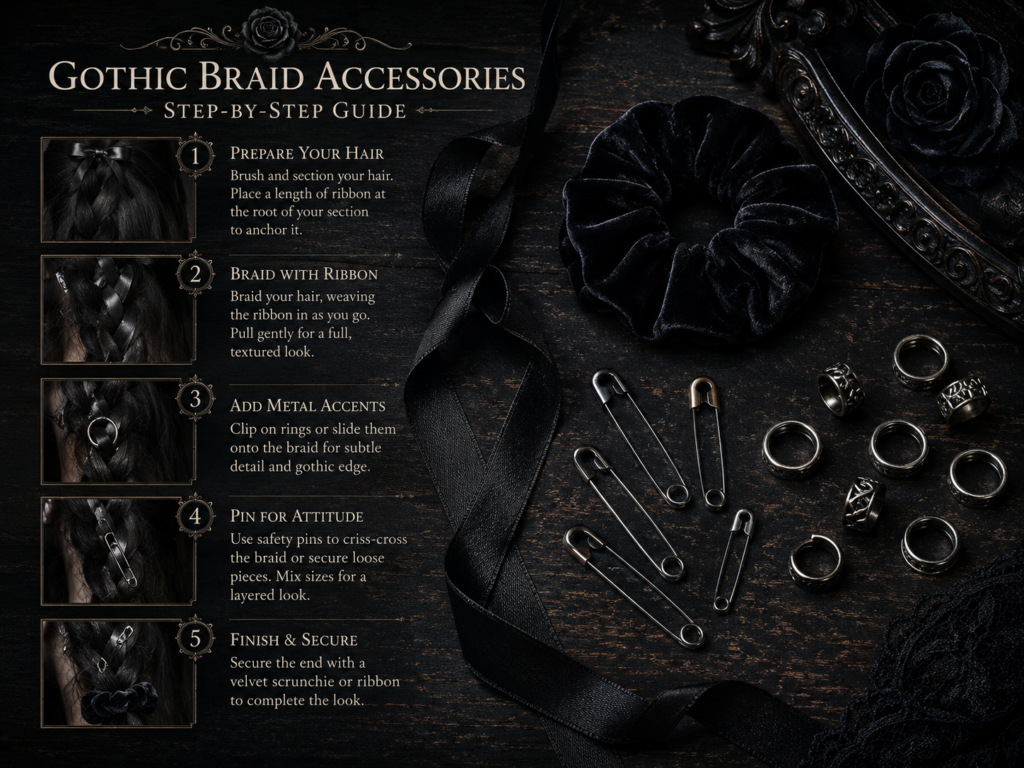
Bubble braids and braided low buns offer similar versatility — structured enough to look put-together, but with enough of a dark accessory detail to signal the aesthetic clearly. A tip worth knowing: use texturising spray or dry shampoo before braiding to give the hair some grip. Smooth hair tends to slip and loosen throughout the day, which works against the clean lines that make these styles look deliberate.
Section 2: Gothic Updos
Gothic updos thrive on contrast. Big, teased crowns paired with sleek, smooth ends. Soft, romantic buns combined with very dark colouring and dramatic eye makeup. Sleek, slicked-back styles finished with a razor-sharp liner. The updo itself doesn’t need to be obviously gothic — it’s often the combination of the style, the colour, and the overall look that creates the effect.
The Teased “Bat’s Nest” Updo
This is the quintessential trad goth updo — heavy teasing at the crown, loosely pinned into a messy bun or half-up shape, with a few sections left trailing at the back. It looks deliberately wild but controlled, which is exactly the point. Micro bangs or a blunt fringe are the styling detail that keeps it from reading as “accidental bedhead” rather than intentional goth.
Building this style properly requires patience with the backcombing. Work in small sections at the crown, teasing each one and pinning as you go rather than trying to tease the whole top at once. Once it’s pinned into position, lightly smooth only the very outermost layer so the style looks intentional. Strong-hold hairspray is not optional here — the volume has to last.
The Romantic Goth Chignon
For events, gothic weddings, or any occasion where you want something elegant rather than aggressively dark, the romantic goth chignon is the answer. A soft, low bun with a few curled pieces left out around the face has a Victorian quality that pairs beautifully with dark dresses, lace, and dramatic eye looks. Add a lace bow, a small veil, or an ornate clip to elevate the styling without overcomplicating the actual bun.
This style translates well to any length that can be gathered into a low bun, and it works with natural texture as well as heat-styled hair. If you’re putting together a full gothic evening look, pairing this updo with a dark lip colour and precise eye work creates a really cohesive finish.
Half-Up Goth Updo
The half-up is probably the most adaptable updo option in this list — it works on almost any length, requires minimal skill, and gives that classic gothic contrast between structured-on-top and flowing-at-the-bottom. Pin or twist the crown section back and secure it with a black bow, a chain-adorned clip, or a statement hair accessory, then leave the rest long and wavy.
The key is in the accessory choice and the makeup. A simple twisted half-up looks unmistakably gothic when you add the right bow or clip detail and pair it with sharp eyeliner and a dark lip. It’s a style that does a lot of work without requiring a lot of effort.
Sleek Everyday Goth Bun
For the days when dramatic teasing isn’t the vibe, a sleek bun still holds its own in the gothic aesthetic. A clean centre part, everything pulled back smoothly into a low or mid bun, with two very thin face-framing strands left out at the front — it’s minimal but still clearly intentional. It’s also one of the most versatile options for school or work environments where elaborate styles aren’t practical.
What keeps this firmly in goth territory is the overall look rather than the hair itself. Dark lipstick, precise liner, and considered gothic accessories do the heavy lifting when the hair is stripped back.
Section 3: Dark Waves and Texture
Dark waves might be the most accessible gateway into gothic hair. They work on almost every length, suit every substyle from soft romantic to grungey alt, and require less technical skill than braids or updos. The key is in the finish — you’re aiming for inky, moody, and textured rather than bouncy or sun-kissed.
“Goth Mermaid” Waves
Think long, dark hair with loose waves that have weight and depth rather than the light, airy quality of beach waves. The colour does a lot of the work here — blue-black, deep burgundy, oil-slick underlayers, or black with visible green or blue tones in certain light all create that quality of darkness that makes the waves feel gothic rather than summery.
To achieve these, use a medium-barrel curling iron, working in sections from underneath the hair upward. Leave the ends slightly uncurled for a more natural finish, then run your fingers through the waves to loosen them slightly. This gives you movement and texture without anything that reads as polished or controlled.
Heatless Goth Waves
If you’d rather skip the heat styling entirely, heatless waves are surprisingly effective — and particularly good for darker hair, which shows texture well. Braid damp hair into two to four loose braids before bed, sleep in them, then undo them in the morning for soft, irregular waves with a naturally undone quality. The more loosely the braids are plaited, the softer and bigger the waves; tighter braids produce more defined, crimped texture.
A twist-and-bun overnight method works if you want something even softer and less defined — coil damp sections into loose buns, secure them, and undo in the morning. The result is a subtle, natural texture rather than a wave pattern, which suits more understated gothic styles.
“Wet” Inky Waves for Evening
For a more dramatic evening look, the “wet wave” finish is particularly striking. Create loose waves with a curling tool, then rake through with fingers and apply a strong gel or gloss product while the hair is still warm. This gives the waves a shiny, wet-look sheen that reads as inky and dark even on lighter hair — especially under certain lighting.
This finish pairs exceptionally well with sharp eyeliner and dark lip colours, creating an overall look that’s deeply dramatic without needing elaborate styling. Keep the makeup precise and the accessories minimal when you’re going for this finish — the hair already makes a strong statement.
Big Trad-Goth Waves
Traditional goth aesthetics call for volume, and that means combining teased roots with waved or curled lengths. Backcomb at the roots to build height, wave or curl the lengths in large sections, then brush them out — not to smooth them, but to break them apart and create that dramatic, brushed-out wave that was iconic in 80s goth. Blunt or micro bangs pushed forward keep this from sliding into glam territory and anchor it firmly in goth aesthetics.
Strong-hold hairspray throughout the process is essential. Apply it at the roots before backcombing, between layers as you build the style, and as a final setting spray. This is a style that has to hold its shape actively — without the right product, the volume will drop quickly.
Adapting These Styles for Different Hair Types
Gothic hairstyles aren’t one-size-fits-all, and the best approach varies depending on your natural hair texture and thickness.
Fine hair benefits most from layered cuts that create the illusion of volume without requiring actual thickness. Smaller backcombing sections work better than large ones, and styles like braids, half-ups, and accessory-heavy options give a lot of visual impact without demanding density. Use plenty of hold product.
Thick or curly hair already has natural volume to work with, which makes pinned crowns, space buns, and loose waves easier to achieve with less effort. Rather than fighting the texture, lean into it — focus on shaping and framing rather than over-styling, and let the natural volume do the work that someone with finer hair would have to create artificially.
Long hair is genuinely the best canvas for most gothic styles. Double braids, braided faux-hawks, bubble braids, and big waves all show off length dramatically. If you’re building your gothic look from scratch, growing your hair out opens up the widest range of options.
Medium and short hair works beautifully with wolf cuts, sharp bobs, mullets, and micro bangs — all of which are well within gothic aesthetics. Texture spray and strong-hold products are particularly important for shorter lengths, where you’re working with less material to create impact. The Halloween Vampire Hair Styles guide also has some useful ideas for creating drama with shorter lengths.
Putting It All Together
The best approach to gothic hair is probably the simplest one: start with one element at a time. Try the double braids one day, add a teased crown to your usual style the next, or just begin with accessories and see how much they transform an otherwise ordinary look. Building a repertoire of styles gradually means you’ll find the ones that actually suit your face shape, your hair type, and your personal aesthetic — rather than working through a list of things that look great on someone else.
The goal isn’t to recreate a specific look exactly. It’s to develop a sense of how these techniques and elements work together, and then apply them in ways that feel like your own version of gothic style. That’s what makes the aesthetic actually interesting — it’s endlessly interpretable.
Continue Your Journey
- Gothic Beauty Routine for Beginners: Your Step-by-Step Guide to Dramatic Dark Beauty — A full starting point for building your gothic look from the ground up.
- Gothic Black Hair Dye: Your Complete Guide to Achieving Perfect Dark Hair — Everything you need to know about going darker, from choosing the right shade to aftercare.
- Gothic Brow Styling Guide — Sharp, defined brows that complement any gothic hairstyle.
- Gothic Lip Colour Guide: Dark Berry, Black, and Burgundy — The full guide to choosing and wearing dark lip colours that work with your overall look.
- Gothic Accessories That Transform Any Outfit — Hair accessories, jewellery, and finishing details that tie a gothic look together.
Which of these three categories — braids, updos, or dark waves — are you most likely to try first? Drop a comment below and let us know if you’d like a deeper tutorial on any of these styles.
Want more gothic style inspiration straight to your inbox? Subscribe to The Gothic World newsletter for new guides, seasonal lookbooks, and dark beauty ideas every week.


