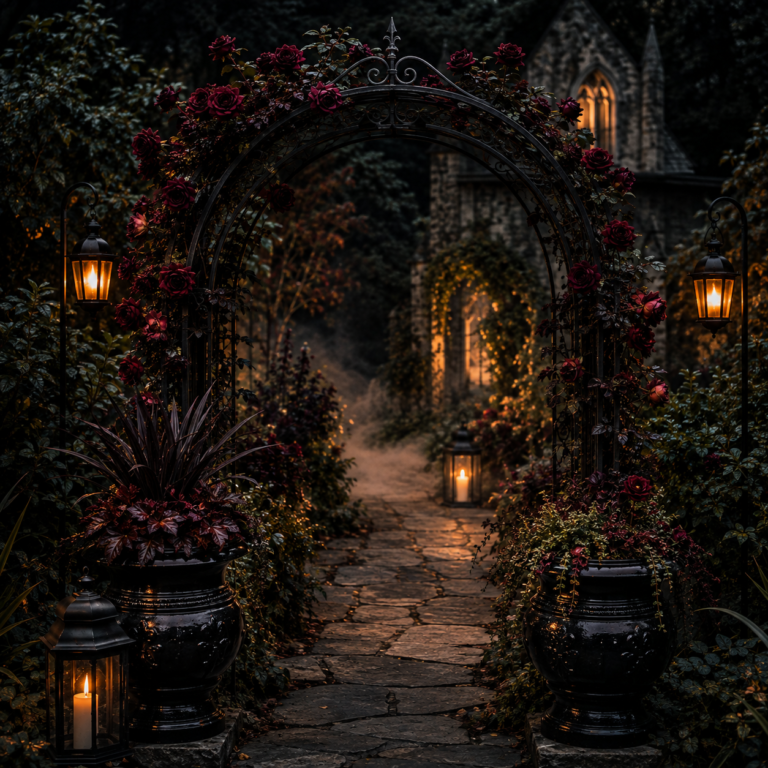
If you’ve already fallen for the idea of a gothic garden, the next question is obvious: which plants actually deliver that moody, near-black drama you’re after? Not every plant marketed as “dark” lives up to its name, and some truly spectacular varieties never make it onto the mainstream garden centre shelf.
As an Amazon Associate I earn from qualifying purchases and sometimes recommend products from other sellers at no extra cost you. For more details see my disclosure policy and privacy policy. Posts may contain AI generated images to illustrate the content.
This guide cuts through the noise. Whether you’re starting from scratch or adding to an existing border, you’ll find the best shrubs, perennials, annuals, and bulbs for a gothic planting scheme — organised by category, with notes on when to buy, when to plant, and where each variety fits best. There’s strong affiliate potential here too, particularly around seeds and bulbs, so I’ve flagged the best options for anyone building a gothic cutting garden or looking to shop online.
Shrubs: The Gothic Backbone
Shrubs are where your gothic garden earns its structure. They give year-round presence, frame other plants, and — when you choose the right varieties — bring deep, moody foliage that holds its colour from spring through to autumn.
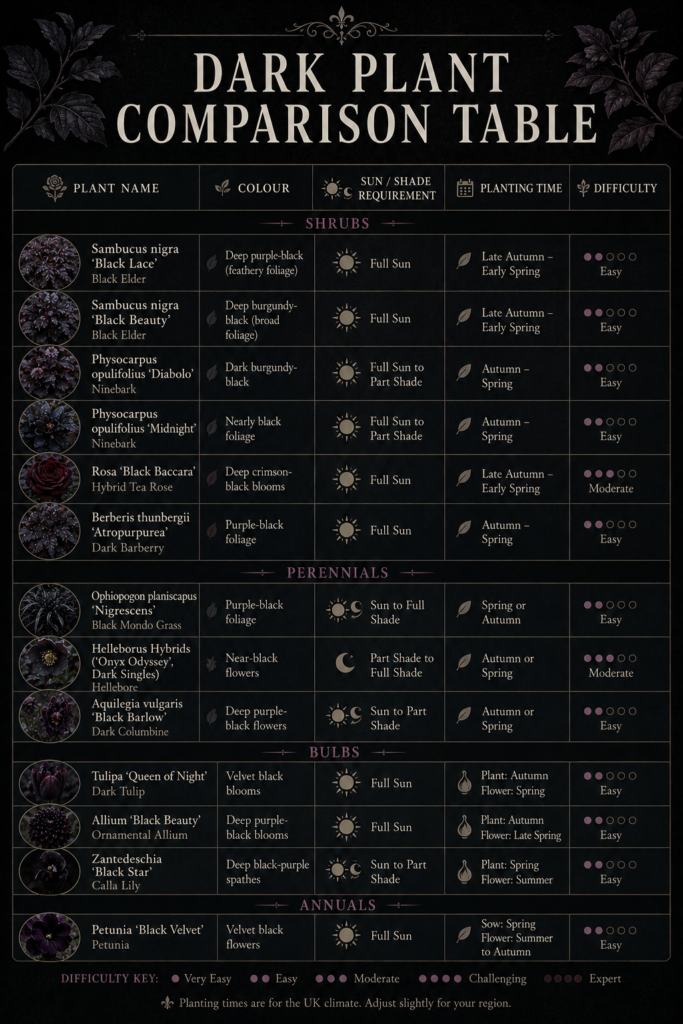
Sambucus nigra ‘Black Lace’ and ‘Black Beauty’ (Black Elder)
These two elders are essentially the unofficial mascots of the gothic garden. Both produce deeply cut, purple-black foliage that holds its colour beautifully across the growing season, and the contrast with their pale pink blossom clusters in early summer is genuinely striking.
Midnight Decor
3D printed gothic pieces
Darkly beautiful objects for the gothic home — printed fresh when you order. Each piece is conjured for your space and entirely yours.


‘Black Lace’ has finer, more feathery leaves — more gothic lace than solid shadow. ‘Black Beauty’ is broader and bolder. Either works as a background shrub or screening plant, and both pair exceptionally well with silver, white, or burgundy planting schemes. Plant bare-root specimens in late autumn through early spring, and give them full sun to get the darkest leaf colour.
Physocarpus opulifolius ‘Diabolo’ and ‘Midnight’ (Ninebark)
Ninebark doesn’t get nearly enough attention in gothic planting circles. ‘Diabolo’ and ‘Midnight’ both carry dark burgundy-black foliage that looks almost bruised in the right light, and the pale blossom clusters they produce in late spring create exactly the kind of morbid contrast that works so well in a dark garden.
They’re structural shrubs — solid and architectural — which makes them ideal as a backdrop for lighter-coloured perennials like white foxgloves or silvery artemisia. Available as small potted shrubs from UK online retailers, they’re a strong affiliate product because they’re a considered purchase rather than an impulse buy.
Rosa ‘Black Baccara’
If you want a statement rose that actually earns the word black, this is it. ‘Black Baccara’ is one of the darkest hybrid tea roses available, producing deep crimson buds that read as near-black in certain light — especially when they’re tightly furled and yet to open.
It works beautifully as a specimen shrub or container plant, and it carries that romantic-gothic energy that connects well with the kind of content covered in the dark romance aesthetic. Bare-root season runs from late autumn through early spring, with main flowering across summer.
Berberis thunbergii ‘Atropurpurea’ (Dark Barberry)
Barberry is a gothic garden workhorse. Spiny and structural, the dark-leaved varieties like ‘Atropurpurea’ bring purple-black foliage with genuine textural interest — and the thorns are, honestly, rather on-brand.
Use it as a low hedge, an edging plant, or anywhere you want a bit of natural security alongside the aesthetics. It looks particularly good against pale gravel or limestone paths, where the contrast between light stone and dark foliage is sharp and dramatic. Plant during the dormant season for best establishment.
Perennials: Moody, Long-Lived Drama
Perennials are the quiet backbone of any serious gothic planting scheme. They return each year, they build up as clumps and drifts over time, and — crucially — the best dark varieties give you consistent colour and texture without the annual effort of re-sowing.
Ophiopogon planiscapus ‘Nigrescens’ (Black Mondo Grass)
This is possibly the most genuinely black plant you can grow in a UK garden. Black mondo grass produces strappy, purple-black foliage that forms low, slowly spreading clumps — perfect along paths, around grave-effect stone features, or as underplanting beneath taller, darker shrubs.
It’s evergreen, which makes it genuinely valuable in the winter garden when almost everything else has retreated. It also works brilliantly in pots, where the blackness of the foliage reads even more dramatically against pale terracotta or stone containers. Plant in spring or autumn; it’s low maintenance once established.
Helleborus Hybrids (‘Onyx Odyssey’, Dark Singles)
Hellebores are the gothic garden’s winter heroes, flowering when almost nothing else dares. The darkest cultivars — particularly the near-black singles and the double ‘Onyx Odyssey’ — produce nodding, deeply coloured blooms from late winter into early spring, often poking through snow or frost.
They’re shade-tolerant, which makes them ideal for darker corners beneath trees or near doorways where little else will grow. They’re sold as potted plants rather than seeds (for the best colour), making them a higher-price-point affiliate option. Plant in autumn or spring, and leave them to naturalise slowly — they improve with age.
Aquilegia vulgaris ‘Black Barlow’ (Dark Columbine)
‘Black Barlow’ is the gothic cottage garden plant. It produces densely doubled flowers in very dark purple-black that look like something between a baroque corsage and a funeral flower, and it self-seeds gently, naturalising across borders in a pleasingly unpredictable way.
It combines brilliantly with ferns and dark grasses in a cottage-goth scheme, and it’s widely available as seed — making it an ideal entry-level affiliate product for readers who want to start growing their gothic garden from scratch. Sow indoors in late winter or direct into the ground in spring; it flowers late spring through early summer.
Alcea rosea ‘Nigra’ (Black Hollyhock)
There are few plants in a gothic garden that make the kind of architectural statement that a black hollyhock does. ‘Nigra’ produces tall spires — sometimes reaching two metres — of very dark maroon-black single flowers that work beautifully against walls, fences, and pergolas.
Sow from seed in late spring for flowering the following year, and give them a position against a warm wall for the best results. They’re technically short-lived perennials (biennial in behaviour), so a rolling programme of sowing every year or two keeps the display continuous. Seed packets are widely available and inexpensive, making this an easy affiliate recommendation alongside a “gothic borders from seed” content angle.
Heuchera: ‘Obsidian’, ‘Black Pearl’, and Dark Cultivars
Dark heucheras are gothic container and border plants at their most accessible. Varieties like ‘Obsidian’ and ‘Black Pearl’ produce near-black, glossy foliage that forms tidy, low mounds — excellent at path edges, in mixed containers, or as contrast planting alongside silver or pale green foliage.
They’re sold as small perennials and plug-plant multipacks, which makes them great value for larger plantings. Most are semi-evergreen in UK conditions, giving year-round colour with minimal effort. Plant in spring or autumn; divide clumps every few years to keep them vigorous.
Dark Dahlias: ‘Arabian Night’, ‘Black Beauty’, ‘Veronne’s Obsidian’
Dahlias are the gothic garden’s late-season showstoppers. The darkest varieties — ‘Arabian Night’, ‘Black Beauty’, and ‘Veronne’s Obsidian’ — produce deep crimson-to-near-black blooms that hit their stride in August and September, exactly when the rest of the border is beginning to fade.
Some of the darkest cultivars also carry dark bronze foliage, which gives them structural interest before the flowers even appear. Tubers are sold in spring and make excellent affiliate products — they’re a considered purchase, they invite repeat buying year on year, and they’re the kind of thing gothic garden enthusiasts genuinely get obsessive about collecting. Plant after the last frosts and they’ll flower through to the first.
Annuals and Bedding: Flexible Gothic Accents
Annuals are where you get to refresh and experiment each year. They’re almost always sold as seed, which makes them a natural fit for affiliate links, and they allow you to shift the balance of your planting scheme from season to season without committing to permanent changes.
Petunia ‘Black Velvet’ and Dark Petunia Varieties
‘Black Velvet’ is one of those plants that genuinely lives up to its name. The flowers are a very deep, velvety near-black — not the muddy dark purple that many “black” petunias turn out to be — and they’re produced continuously throughout summer.
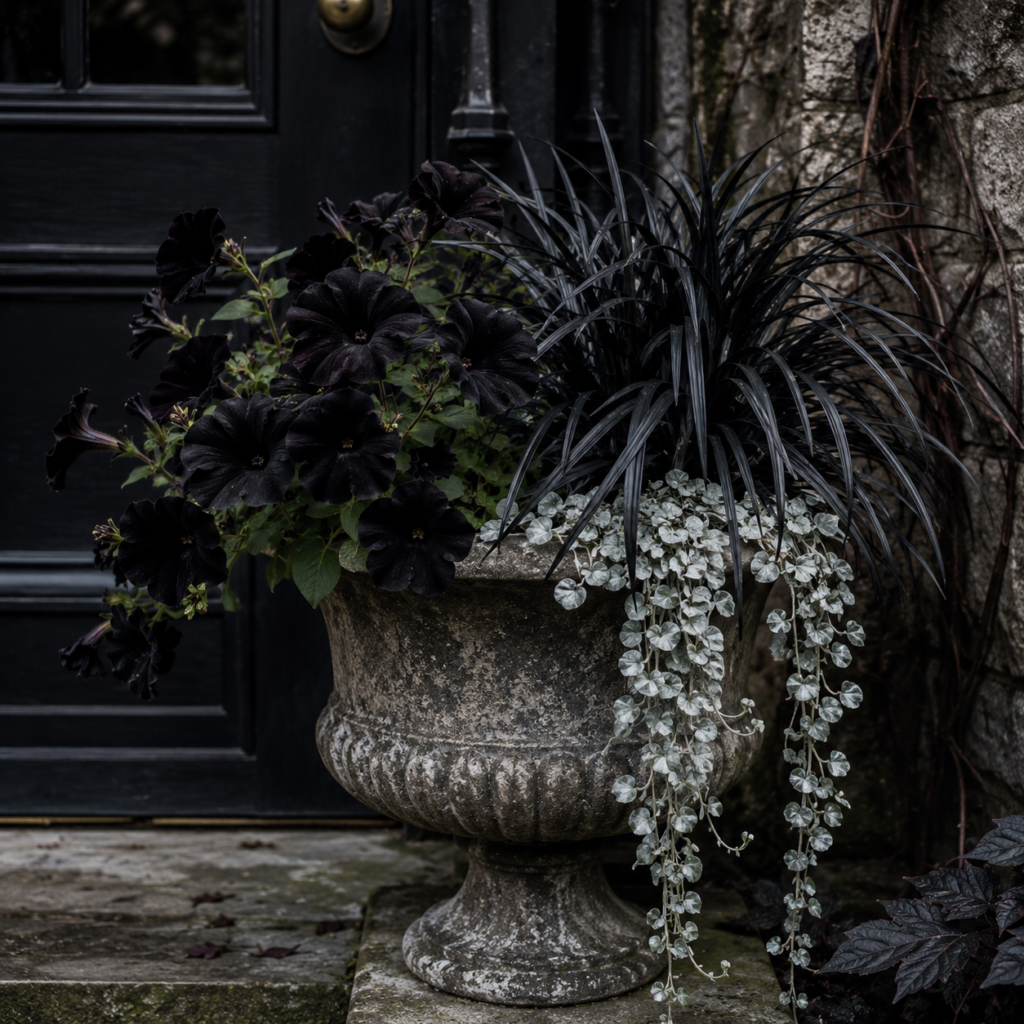
They’re particularly effective in pots and window boxes by doorways, where they can be combined with white or silver plants for stark, elegant contrast. Available as seed and as plug bedding plants, they’re best sown under cover in late winter and planted out after the last frost.
Sweet Pea ‘Almost Black’
Sweet peas are not an obvious gothic garden choice — but ‘Almost Black’ changes that entirely. The blooms are a deep maroon-black with that unmistakable sweet pea fragrance, which adds an unexpected sensory dimension to a gothic planting scheme.
Train them up obelisks, arches, or trellis panels along a gothic garden path for maximum drama. They’re sold as seed packets and fit naturally into a “dark cottage garden” or “gothic cut flower garden” content angle. Sow in autumn under cover or in early spring for flowers from early to midsummer.
Papaver somniferum ‘Black Peony’ (Dark Poppy)
‘Black Peony’ is a self-seeding annual that brings a wild, slightly sinister quality to summer borders — dark, frilly, near-black double blooms on elegant tall stems that move beautifully in the wind.
Once you’ve grown poppies and allowed them to set seed, they naturalise readily, creating a slightly unpredictable effect that suits the gothic garden aesthetic well. Seed packets are widely available and inexpensive; they’re a great basket-builder alongside other dark-flower seed purchases.
Dark Coleus: ‘Black Prince’ and Dark Foliage Mixes
For deep, season-long gothic colour in shady corners, dark coleus varieties are hard to beat. ‘Black Prince’ produces very deep burgundy-to-black leaves, often with contrasting edges, and they hold their colour throughout the growing season without fading.
They’re treated as half-hardy annuals in UK conditions — sow in late winter and plant out after the last frost. They work particularly well in pots in darker courtyard gardens or alongside doorways, where the intensity of the foliage colour can be appreciated up close.
Night-Scented Dark Annuals: Nicotiana ‘Black Knight’
For an evening garden with genuine atmosphere, don’t overlook night-scented annuals. Nicotiana ‘Black Knight’ produces very dark, almost black tubular flowers that release their scent as evening falls — exactly the kind of sensory experience that elevates a gothic garden beyond purely visual interest.
Position near seating areas, pathways, or any outdoor space where you spend time after dark. Seed packets are low-cost and high-value, making them ideal for recommending alongside heavier purchases. Sow under cover in early spring; they flower from summer into autumn.
Bulbs and Corms: Gothic Highlights by Season
Bulbs are one of the best categories for gothic garden affiliate content. They ship well, they’re almost always sold online, they invite repeat purchasing year after year, and the best dark varieties sell out early — which creates a genuine sense of urgency in your content.
Tulip ‘Queen of Night’, ‘Black Parrot’, and ‘Black Hero’
‘Queen of Night’ is arguably the most iconic black tulip in cultivation. It’s a deep, velvety, near-black single tulip that photographs beautifully and has genuine crossover appeal beyond the gothic community — which means it converts well as an affiliate product.
‘Black Parrot’ brings frilled, feathered petals to the same dark colour palette, while ‘Black Hero’ is a dark, double variety that stays in bloom for longer than most tulips. Plant bulbs in autumn for mid-to-late spring flowering, and consider recommending “black tulip collections” which bundle several varieties together for a higher basket value.
Iris ‘Old Black Magic’ and Dark Bearded Irises
Dark bearded irises are a slightly niche purchase — but they reward the gardener who seeks them out. ‘Old Black Magic’ produces very dark, velvety petals with falls that look almost black in certain light, and they’re a strong structural accent in a mid-to-late-spring gothic border.
Sold as rhizomes (bare-root), they’re planted in late summer for flowering the following late spring. The planting timing is different enough from most other bulbs that they slot naturally into a “summer planting guide” content piece.
Calla Lilies and Dark Asiatic Lilies: ‘Black Pearl’
Dark calla and asiatic lily varieties bring genuine summer drama to gothic containers and cutting gardens. Deep maroon-black blooms work beautifully as cut flowers — which connects well with anyone interested in gothic floral arrangements or dark decor, something the gothic autumn decor aesthetic lends itself to naturally.
Bulbs and tubers are widely sold in spring. They’re a higher-price-point purchase with strong visual appeal, making them ideal for feature placement in affiliate content.
Voodoo Lilies and Gothic Oddities: Dracunculus, Amorphophallus
For the genuinely committed gothic gardener, voodoo lilies and their relatives are in a category of their own. Dracunculus vulgaris (the dragon arum) produces a startlingly dark, almost black spathe that’s one of the most dramatic flowers you’ll see in any UK garden — though fair warning, it smells briefly of rotting flesh to attract pollinators.
These are niche, conversation-piece plants — more at home with the kind of gardener who reads about gothic lifestyle in depth. Best grown in pots in cooler climates or given a sheltered spot; plant tubers in spring for warm-weather flowering.
Building Your Gothic Garden by Season
Getting the timing right makes a real difference to how much you can achieve in a gothic garden. Here’s a seasonal framework for a UK audience:
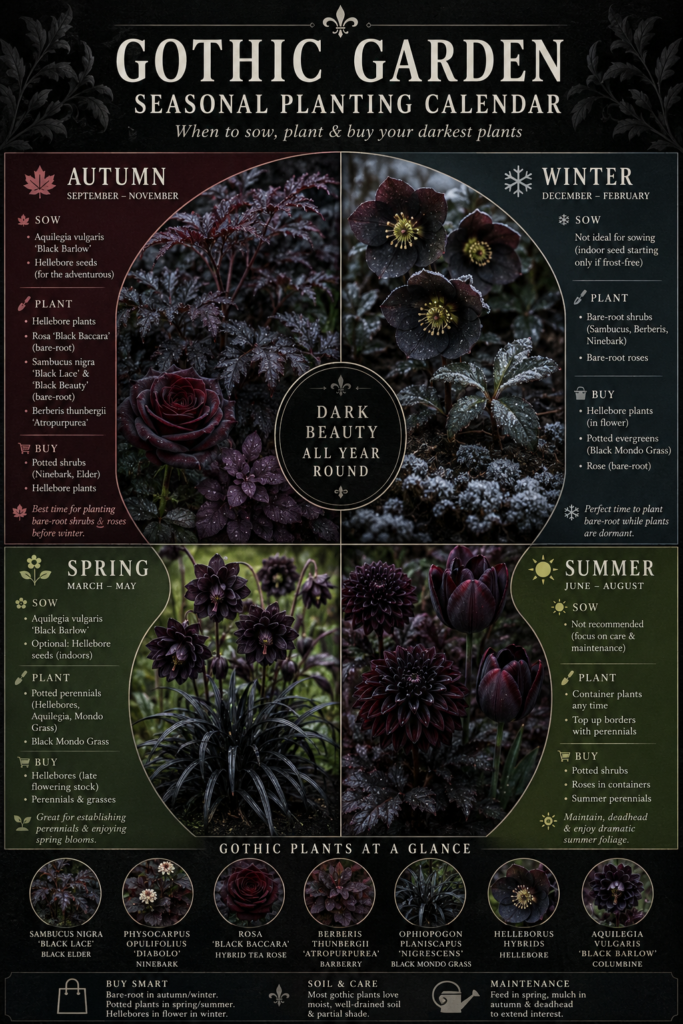
Autumn (September–November)
- Plant tulip bulbs — order ‘Queen of Night’, ‘Black Parrot’, and ‘Black Hero’ before they sell out.
- Order and plant bare-root roses (Black Baccara) and shrubs (Sambucus, Physocarpus).
- Get hellebores into position now for late-winter flowering.
Winter (December–February)
- Focus on seed ordering: black hollyhocks, ‘Black Barlow’ aquilegia, dark sweet peas.
- Hellebores are the gothic garden’s great contribution to this season.
- Plan container recipes and sketch your spring planting scheme.
Spring (March–May)
- Plant black mondo grass, heucheras, and container perennials.
- Sow dark petunias, coleus, and nicotiana under cover; plant out after frosts.
- Order dahlia tubers now — the best dark varieties sell out before the weather warms.
Summer (June–August)
- Dahlias, dark lilies, black irises, and full-foliage shrubs are at their peak.
- Take stock of gaps and plan autumn bulb orders.
- Sweet peas, poppies, and dark annuals are in full swing.
Container Recipes for Gothic Pots
Not everyone has a full garden to work with, and a gothic planting scheme works just as well — sometimes better — in containers. These combinations work particularly well:
- Doorstep Drama: Black petunia + black mondo grass + white trailing lobelia. The contrast is stark and elegant, and it scales from a small pot to a large statement planter.
- Moody Summer Pot: Dark dahlia tuber + dark heuchera + trailing silver dichondra. Structural, textural, and deeply gothic in colour.
- Winter-Into-Spring Container: Hellebore ‘Onyx Odyssey’ + black mondo grass + white cyclamen. Works from November through to April.
Putting It All Together
A gothic garden doesn’t need to be entirely black and dark — in fact, the most effective gothic planting schemes use contrast deliberately. Near-black foliage reads most dramatically against pale gravel, white flowers, or silver-leaved plants like artemisia and stachys. Deep crimson and dark purple work alongside each other naturally, while occasional touches of blood red or white sharpen the overall effect.
Start with one or two strong shrubs for structure, add a layer of dark perennials for consistency, then use annuals and bulbs to shift the seasonal emphasis and try new varieties each year. The gothic garden guide covers the design principles in more depth if you’re working from scratch — the plant palette here gives you the specific varieties to bring it to life.
Want to keep building your dark garden aesthetic indoors too? Explore the full guide to gothic interiors for ideas on carrying the mood through the whole house.
Continue Your Journey
- The Gothic Garden: Your Complete Guide to Dark Foliage, Black Flowers, and Moody Night Gardens — the pillar guide to planning your gothic outdoor space from scratch
- Gothic Autumn Decor: Transform Your Space with Dark, Seasonal Elegance — how to bring that moody seasonal palette indoors
- Creating a Gothic Reading Nook: Your Personal Dark Academia Sanctuary — gothic atmosphere for indoor spaces
- Dark Gemstones for Statement Jewellery: Your Guide to Gothic Elegance — dark colour and texture beyond the garden
- Designing Your Space: An In-Depth Guide to Goth Interiors — the full interior design companion
What’s your gothic garden must-have? Are you a tulip ‘Queen of Night’ devotee, a dark dahlia obsessive, or are you starting from seed this year? Drop a comment below — I’d love to know what’s growing in your dark corners.
If you want more gothic garden and lifestyle content straight to your inbox, subscribe to The Gothic World newsletter for seasonal guides, dark plant picks, and interiors inspiration.