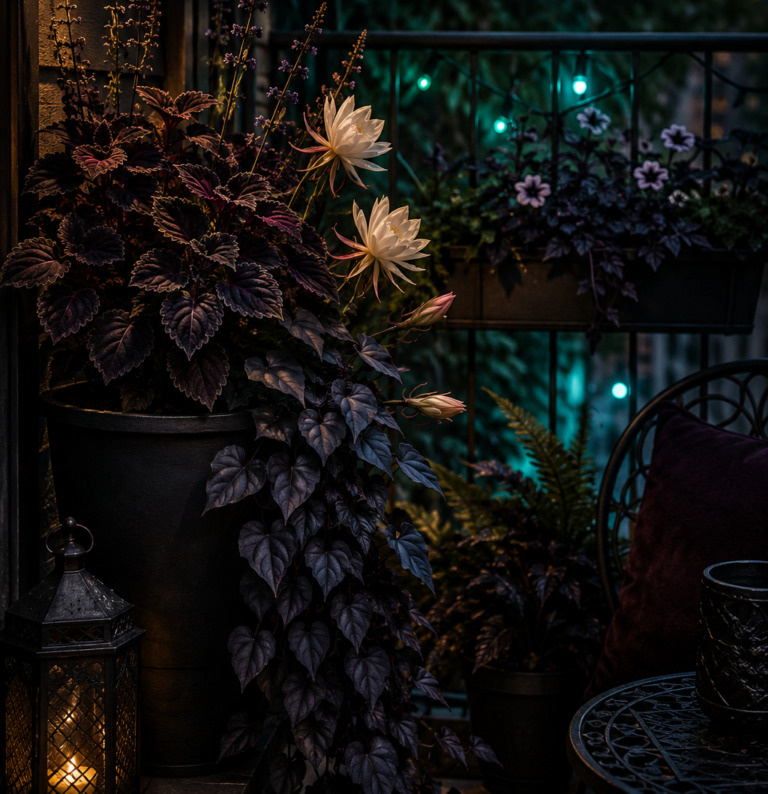
There’s something almost defiant about planting a gothic garden. While most gardening content pushes cheerful cottage blooms and sun-drenched borders, you’re reaching for the shadows — deep burgundy dahlias that drink in the light, inky black tulips rising from frost-cold soil, silver moonflowers spilling open only once the rest of the world has gone to bed. This isn’t just gardening. It’s an extension of how you live.
As an Amazon Associate I earn from qualifying purchases and sometimes recommend products from other sellers at no extra cost you. For more details see my disclosure policy and privacy policy. Posts may contain AI generated images to illustrate the content.
Gothic gardening is having a genuine cultural moment right now. Dark foliage, moody planting palettes, and the concept of the night garden — a space designed to come alive after dusk — have broken well beyond the goth subculture into mainstream garden design. But nobody does it with as much intention as someone who actually lives this aesthetic. This guide covers everything you need to create a gothic outdoor space that reflects your style year-round, whether you’re working with a sprawling back garden, a small paved courtyard, or a collection of pots on a flat roof.
If you’ve already built your gothic world indoors — you might already have a gothic interior design style sorted — then this is the natural next step. Your garden is just another room.
Why Gothic Gardening Is Having a Moment
The trend itself makes a lot of sense when you think about it. After years of Pinterest-perfect pastel gardens and blush-and-white “soft romantic” planting schemes, gardeners are hungry for something with more drama. Dark foliage plants like the black elephant ear (Colocasia esculenta ‘Black Magic’) and deep purple smoke bush (Cotinus coggygria ‘Royal Purple’) have been mainstream nursery staples for years — but the aesthetics community is now styling entire gardens around them rather than using them as mere accents.
Midnight Decor
3D printed gothic pieces
Darkly beautiful objects for the gothic home — printed fresh when you order. Each piece is conjured for your space and entirely yours.


The night garden concept has its own logic, too. People who work long hours, who live a more nocturnal lifestyle, or who simply want to actually use their garden in the evenings rather than just look at it from the kitchen window — all of these groups are driving real interest in plants that perform at night. White and silver plants catch moonlight and artificial light beautifully. Night-scented blooms fill the air with fragrance exactly when you’re outside to enjoy it.

For gothic lifestyle enthusiasts, this trend is genuinely affirming. The things that have always made sense to us — the romance of darkness, the beauty in things that others find morbid or strange, the preference for depth over brightness — all of these translate perfectly into outdoor spaces.
The Two Pillars of a Gothic Garden
Before getting into specific plants and design elements, it’s worth understanding the two distinct aesthetics that sit at the heart of gothic gardening. Many gardens combine both, but knowing which one speaks to you will help you make more intentional choices.
What Type of Gothic Garden Suits You?
Answer four questions to find your perfect dark garden style.
The Dark Garden: Moody Foliage and Deep Colour
This is the gothic garden most people picture first. Deep purples, near-blacks, rich burgundies, and shadowy greens. The palette is saturated and brooding, and the effect in daylight is genuinely dramatic — especially when contrasted with pale stone paths, weathered iron, or bare soil between planting. The dark garden draws from Victorian and medieval gardening traditions, the poison garden aesthetic, and the kind of wild, overgrown formality you’d find in a ruined estate.
Key to this style is the layering of dark foliage with deep-coloured flowers, so that the drama never depends on a single plant having a good week. When the black dahlias are past their peak, the smoke bush still holds court. When the deep red roses are resting, the black mondo grass keeps the ground plane interesting.
The Night Garden: Silver, White, and Luminous Planting
The night garden is less about darkness and more about what happens when you take the colour away. White, silver, cream, and pale grey plants have an extraordinary quality at dusk — they seem to glow, to hold onto light long after everything else has faded. Planting a section of your garden with these luminous shades, or designing an entire space around them, means that the space genuinely comes to life in the evening hours.

This aesthetic draws from the Edwardian tradition of the white garden (Vita Sackville-West’s famous White Garden at Sissinghurst being the most celebrated example), but filtered through a gothic sensibility — so you’d choose ghost plants over standard white roses, moonflowers over daisy borders, silver artemisia over generic white bedding plants.
Dark Foliage: The Backbone of a Gothic Garden
Flowers come and go, but foliage is what gives your garden structure across the whole season. Building a strong framework of dark-leaved plants means your garden looks intentional even in the bleakest January week. This is where gothic lifestyle principles — commitment to an aesthetic over trend-chasing — really pay off in the garden.
Quick Reference: Dark Plants for a Gothic Garden
At a glance — plant type, season of interest, light requirements, and where to buy seeds, bulbs, or established plants.
| Plant | Type | Season of Interest | Light | Find It |
|---|---|---|---|---|
|
Queen of the Night Tulip
Tulipa ‘Queen of the Night’
|
Bulb | ☀️ Full sun | Buy Bulbs → | |
|
Heuchera ‘Obsidian’
Heuchera ‘Obsidian’
|
Perennial | ⛅ Part shade | Buy Plant → | |
|
Black Mondo Grass
Ophiopogon planiscapus ‘Nigrescens’
|
Grass | ⛅ Sun or shade | Buy Plant → | |
|
Dark Dahlia
‘Chat Noir’ / ‘Arabian Night’
|
Bulb / Tuber | ☀️ Full sun | Buy Tubers → | |
|
Purple Smoke Bush
Cotinus coggygria ‘Royal Purple’
|
Shrub | ☀️ Full sun | Buy Plant → | |
|
Hellebore (dark varieties)
Helleborus x hybridus
|
Perennial | 🌑 Shade | Buy Plant → | |
|
Clematis ‘Romantika’
Clematis ‘Romantika’
|
Climber | ☀️ Full sun | Buy Plant → | |
|
Artemisia ‘Powis Castle’
Artemisia arborescens ‘Powis Castle’
|
Perennial | ☀️ Full sun | Buy Plant → | |
|
Nicotiana sylvestris
Woodland Tobacco
|
Annual | ⛅ Sun / part shade | Buy Seeds → | |
|
Bronze Fennel
Foeniculum vulgare ‘Purpureum’
|
Herb | ☀️ Full sun | Buy Seeds → | |
|
Chocolate Cosmos
Cosmos atrosanguineus
|
Tender Perennial | ☀️ Full sun | Buy Plant → |
Shrubs and Statement Plants
Cotinus coggygria ‘Royal Purple’ (Purple Smoke Bush) is arguably the single most impactful dark foliage shrub available to UK and northern European gardeners. The leaves emerge almost black in spring before settling into a rich plum-purple through summer. The common name comes from the hazy, smoke-like flower plumes that appear in late summer and persist into autumn. Left to grow naturally, it’ll reach 3–4 metres; coppiced hard each spring, it produces enormous, almost tropical-looking leaves that stay darker for longer.
Sambucus nigra ‘Black Lace’ (Black Elder) gives you finely cut, near-black foliage on an easy-to-grow shrub that also produces dusky pink flowers in summer and dark elderberries in autumn. It’s more elegant than blunt, and the lacy texture stops it reading as heavy even in small spaces.
Physocarpus opulifolius ‘Diabolo’ (Ninebark) is less commonly grown but deeply satisfying — the deep purple-burgundy leaves on this compact shrub hold their colour reliably all season, and the peeling bark gives winter interest too.
Perennials and Ground Cover
Heuchera varieties have transformed gothic gardening options. ‘Obsidian’ produces deep, near-black leaves with a metallic sheen. ‘Palace Purple’ sits in a rich burgundy range. These work beautifully as ground cover, in pots, and massed at the front of borders. They’re genuinely evergreen in mild winters, which makes them essential.

Ophiopogon planiscapus ‘Nigrescens’ (Black Mondo Grass) is one of the very few plants that genuinely earns the description “black.” A slow-growing, grass-like perennial, it creeps through the soil creating dark ribbons that look extraordinary against pale gravel, light stone, or white-flowering plants. Patience required — but absolutely worth it.
Ajuga reptans ‘Catlin’s Giant’ offers dark bronze-purple leaves in a fast-spreading ground cover with deep blue flower spikes in spring. Excellent for knitting together darker corners and suppressing weeds beneath shrubs.
Black and Deep Purple Flowers: Drama in Bloom
The pursuit of truly black flowers is a long-running obsession in horticulture, and while pure black doesn’t quite exist in nature, the flowers that come closest are remarkable to see in person — especially photographed with strong backlight, where petals that appear blackish in shade suddenly reveal their true plum or burgundy depth.
Spring Flowering
Queen of the Night tulips are the definitive spring gothic flower. These tall, satiny tulips open to a deep maroon-purple that photographs almost black in the right light, and they carry themselves with exactly the kind of elegance you want — single blooms on long, upright stems, none of the fussy complexity of parrot tulips. Plant bulbs generously in autumn for the most impact.
Helleborus x hybridus (Lenten Rose) is the other great spring staple for gothic gardens. The near-black varieties are stunning — nodding, cup-shaped flowers in the darkest possible shades, appearing from January onwards when almost nothing else is in bloom. They’re essentially evergreen, deeply shade-tolerant, and once established, virtually indestructible.
Fritillaria persica ‘Adiyaman’ produces tall, slightly sinister spikes of deep plum-purple bell-shaped flowers in mid-spring. Unusual, architectural, and genuinely hard to find elsewhere in the plant world.
Summer Flowering
Dark dahlias are the heart of the summer gothic garden. ‘Chat Noir’ and ‘Black Beauty’ produce near-black ball and decorative forms; ‘Arabian Night’ gives deep scarlet-black. Dahlias are hungry plants that repay feeding generously — they’ll reward the effort with flowers right through until the first frosts. Lift and store tubers in colder regions.
Cosmos atrosanguineus (Chocolate Cosmos) is extraordinary — deep maroon, velvety flowers with a genuine warm chocolate scent. It’s a tender perennial best treated as an annual in the UK, but the combination of unusual colour and fragrance makes it well worth growing every year.
Scabiosa atropurpurea ‘Chile Black’ (Black Pincushion Flower) produces small, pincushion-shaped blooms in the deepest possible purple, almost black in the bud. They work well cut for arrangements indoors — aligning nicely with the gothic home decor aesthetic when brought inside.
Climbing Plants
Clematis ‘Black Prince’ and Clematis ‘Romantika’ both produce deep purple-black flowers on climbers that can be trained across walls, fences, and arches. Clematis are perfect gothic garden plants — dramatic in flower, with interesting seed heads in autumn, and utterly at home scrambling over old stone or dark iron structures.
The Night Garden: White, Silver, and Luminous Plants
A purely dark garden can feel one-note without the contrast of something lighter. White and silver plants aren’t a compromise — they’re an essential part of the gothic gardening palette, bringing in the ghostly, lunar quality that transforms a garden from merely dark to genuinely otherworldly.
White Flowering Plants for After Dark
Brugmansia (Angel’s Trumpet) is a show-stopper — enormous, pendulous, trumpet-shaped white flowers that release a heavy, sweet fragrance specifically at night when they’re pollinated by moths. They’re frost-tender in the UK and need to be brought inside for winter, but a single well-grown specimen is a statement piece that justifies the effort entirely.
Nicotiana sylvestris (Woodland Tobacco) produces long, white, tubular flowers on tall plants that reach 1.5 metres or more. Like Brugmansia, the fragrance is released predominantly in the evening, making it perfectly suited to spaces you use after work. Grow as an annual — it self-seeds prolifically in mild conditions.
Ipomoea alba (Moonflower) is the classic night-blooming vine — enormous, pure white, fragrant flowers that open in the evening and close by morning. Grow it up a fence, trellis, or dark-painted wall for full effect.
Datura metel (Devil’s Trumpet) offers similar drama to Brugmansia with deeply fragrant white flowers. Note that all parts of both Datura and Brugmansia are toxic, so keep them away from children and pets.
Silver Foliage for Moonlight Effect
Artemisia ‘Powis Castle’ is the silver plant against which all others are measured — a billowing, deeply cut, almost luminous silver-grey that catches light at any hour. It’s structural, long-lived, and complements dark foliage beautifully.
Stachys byzantina (Lamb’s Ear) gives you dense, furry silver ground cover that holds onto dew and practically glows on overcast days. It’s tactile, soft, and almost wool-like in texture.
Cynara cardunculus (Cardoon) brings dramatic architectural presence with deeply silver-grey, spiny leaves that can reach 2 metres across. The purple thistle flowers appear in summer and are loved by bees before turning to extraordinary dried seed heads that last into winter.
Gothic Garden Design: Structure, Paths, and Atmosphere
Plants make the palette — but structure gives a gothic garden its character. This is where you can make design choices that signal the aesthetic without ever needing to explain it to anyone who walks through your gate.
Paths and Hard Landscaping
Slate chippings and dark gravel are the obvious choices for a gothic garden and work brilliantly — they create a contrast with lighter plants and age into the garden naturally. Reclaimed stone slabs, especially those with a slightly uneven, weathered character, give exactly the feeling of a garden that has been there long before you and will be there long after.
Winding paths are fundamentally more gothic than straight ones — they create the sense of discovery, of not being able to see around the corner, that makes a garden feel like an experience rather than just a space. If your garden is small, even a gentle curve makes a significant difference.
Structures and Focal Points
Iron arches, obelisks, and trellises age into gothic gardens beautifully — they rust, they accumulate patina, they become part of the planting as climbers move through them. A wrought iron arch draped in dark clematis is one of the most satisfying things a gothic garden can offer.
A stone water feature — even a simple birdbath — adds both the visual and acoustic presence of water and also, in the evening, reflects light in ways that dramatically change the atmosphere of a space. Pair with dark aquatic plants or floating candles for a genuinely theatrical effect.
For those who use their gardens in the evening, lighting is everything. Solar-powered black metal lanterns, string lights used sparingly, and candles in dark lanterns all add atmosphere without the clinical flatness of bright outdoor floodlighting. You want to create pools of light and shadow, not eliminate shadow entirely.
Seasonal Interest Through the Year
A well-planned gothic garden has something to offer in every season, which is a key argument for turning this into a proper cluster of content — and for building the garden with year-round structure in mind, rather than loading up on summer flowers alone.
Gothic Garden Seasonal Plant Calendar
When each type of plant is at its peak, growing, or offering structural interest through the year.
← Scroll to see all months →
| Winter | Spring | Summer | Autumn | |||||||||
|---|---|---|---|---|---|---|---|---|---|---|---|---|
| Plant Category | Jan | Feb | Mar | Apr | May | Jun | Jul | Aug | Sep | Oct | Nov | Dec |
| Dark Foliage | ||||||||||||
| Heuchera ‘Obsidian’Near-black evergreen | ||||||||||||
| Cotinus ‘Royal Purple’Purple Smoke Bush | ||||||||||||
| Sambucus ‘Black Lace’Black Elder | ||||||||||||
| Black Mondo GrassOphiopogon ‘Nigrescens’ | ||||||||||||
| Near-Black & Deep Colour Flowers | ||||||||||||
| Hellebores (dark vars.)Winter to spring bloom | ||||||||||||
| Queen of the Night TulipsSpring bulbs | ||||||||||||
| Dark Dahlias‘Chat Noir’, ‘Arabian Night’ | ||||||||||||
| Clematis (dark vars.)‘Romantika’, ‘Black Prince’ | ||||||||||||
| White & Silver (Night Garden) | ||||||||||||
| Artemisia ‘Powis Castle’Silver foliage | ||||||||||||
| Nicotiana sylvestrisFlowering tobacco — annual | ||||||||||||
| Moonflower (Ipomoea alba)Night-blooming vine | ||||||||||||
| Gothic Herbs | ||||||||||||
| Bronze FennelCopper-bronze structural herb | ||||||||||||
| Purple SageSalvia officinalis ‘Purpurascens’ | ||||||||||||
| Dark Opal BasilNear-black annual herb | ||||||||||||
| Structural & Year-Round Interest | ||||||||||||
| Twisted HazelCorylus ‘Contorta’ | ||||||||||||
| Dark Seed HeadsEryngium, Allium, Fennel | ||||||||||||
Spring brings the dark tulips, hellebores, and early Fritillaria. Summer delivers the dahlias, roses, cosmos, and night-blooming vines at full intensity. Autumn is possibly the most naturally gothic season of all — the seed heads of eryngium and dark alliums, the berries of black elderberry, the changing foliage of the smoke bush. And winter, often dismissed by gardeners as the dead season, is where the structural bones of a gothic garden really show — twisted hazel branches, the persistent evergreen of heuchera and black mondo grass, the graphic forms of bare stems against a pale sky. It connects naturally to what many of us do outdoors in autumn around Halloween decorating season, when the garden itself becomes the backdrop.

Herbs, Tradition, and the Poison Garden Aesthetic
There’s a strong historical current running through gothic gardening — specifically the tradition of the physic garden, the poison garden, and the medieval herb garden. These spaces were practical (medicine, cooking, pest control) but they carry a dark romance in their history that fits perfectly with the gothic aesthetic.
Growing herbs for a gothic garden doesn’t mean growing dangerous plants. It means choosing varieties with dark foliage, intense fragrance, and a bit of historical weight:
- Purple sage (Salvia officinalis ‘Purpurascens’) — deep purple-green leaves, edible, beautifully aromatic
- Dark opal basil — near-black leaves with a complex, peppery fragrance; a summer annual that looks extraordinary in pots
- Bronze fennel — feathery, copper-bronze foliage reaching impressive heights, with a strong aniseed fragrance; the perfect gothic structural herb
- Black elderflower — the full plant offers flowers, berries, and lacy near-black foliage from ‘Black Lace’; elderflower cordial has genuine folk history tied to this plant
- Wormwood (Artemisia absinthium) — intensely bitter, strongly aromatic, and the source plant for absinthe; the silver-grey foliage adds to the moonlight garden palette
The Alnwick Garden in Northumberland has the UK’s most famous poison garden, and it’s genuinely worth a visit if you want to understand just how dramatic and well-designed a formal gothic herb garden can be. Their commitment to educating visitors about the history of poisonous plants is fascinating.
A note on genuinely toxic plants: Belladonna, wolfsbane, and other traditional “gothic garden” plants are beautiful but carry real risks, particularly for children and pets. If you want to grow them — and some gardeners with fully enclosed, child-free spaces do — research the specific risks thoroughly and keep them clearly labelled. If any doubt exists, focus on the safer alternatives that deliver similar aesthetic results.
Container Gardening: Gothic Gardens for Any Space
Not everyone has a plot of land. Balconies, patios, courtyards, and flat roofs can all become gothic gardens with the right approach to containers. The key is to think in the same structural terms as a ground-level garden — you need height, you need a mid-layer, and you need something trailing or at ground level — but deliver it all through pots.
Large architectural containers work best for statement plants: a large terracotta pot (painted matte black or aged with concrete paint) planted with a Heuchera ‘Obsidian’, a trailing Ipomoea batatas ‘Blackie’ (black sweet potato vine), and perhaps a small dark-leaved Phormium for height. This creates a complete planting picture in a single container.
Dark pots themselves matter. Matte black metal planters, aged concrete troughs, and dark-glazed ceramic pots all read as part of the gothic aesthetic. Avoid terracotta in its natural orange-red state — it actively works against the palette — unless you’re aging or painting it.
Night garden containers are particularly effective on balconies: plant Nicotiana and white Ipomoea alba in tall, dark pots positioned near where you sit in the evening, and the fragrance and white flower glow creates an extraordinary atmosphere in a compact space.
Practical Basics: Soil, Feeding, and Getting Started
Gothic gardening is still gardening, which means the fundamentals remain exactly the same as any other approach.
Soil Preparation
Most dark-flowered plants — particularly dahlias and roses — prefer rich, well-draining soil with plenty of organic matter. Before planting a new border, incorporate well-rotted compost or manure at roughly a bucket per square metre. Hellebores prefer a more free-draining, slightly alkaline soil; if your ground is heavy clay, raise beds slightly or add grit.
For containers, use a good quality peat-free compost mixed with approximately 20–30% perlite or horticultural grit for drainage. Most of the plants that work well in gothic containers are not fans of sitting in wet soil over winter.
Watering and Feeding
Dahlias and summer-flowering perennials are hungry and thirsty. A liquid feed high in potassium (tomato feed works well) applied weekly from midsummer gives significantly better flowering results. Dark-leaved heucheras and other foliage plants need less feeding but appreciate a slow-release granular fertiliser in spring.
Year-Round Maintenance
Deadheading dark flowers — dahlias especially — is time-consuming but genuinely extends the flowering season significantly. Resist the temptation to cut back all seed heads in autumn; many of them (eryngium, dark alliums, fennel) look architecturally beautiful through winter and provide food for birds.
Building a Gothic Garden Cluster: Content and Community
If you’re in the process of creating a gothic garden — or even just considering it — you’re already participating in a growing conversation. The dark garden aesthetic has active communities on Instagram and Pinterest, and an increasing number of specialist nurseries focusing on unusual dark-coloured varieties. Searching “moody garden,” “dark foliage plants,” or “night garden” on Pinterest returns thousands of genuinely gorgeous results that go far beyond the obvious Halloween staging.
The connection to broader gothic lifestyle interests is strong and natural. The dark garden connects to seasonal living, to a relationship with nature that isn’t pastoral and sunlit but complex and atmospheric. It connects to the same sensibility that drives interest in gothic home decor and gothic autumn decorating ideas. It’s about choosing to live beautifully in the darker parts of the aesthetic spectrum, year-round, rather than just at Halloween.
Getting Started: Your First Gothic Garden Season
If this is your first gothic garden, the temptation is to do everything at once. Resist it. Start with three things that give you maximum impact for minimum investment, then build from there.
Start with structure first. One dark-leaved shrub — a small smoke bush, a ‘Black Lace’ elder, or a collection of heuchera — establishes the palette before you spend money on flowers. Structure lasts for decades; flowers are annual decisions.
Add one night garden element. Even a single pot of Nicotiana sylvestris positioned near where you sit in the evening transforms the experience of being outside after dark. Night fragrance is the most overlooked element in most gardens.
Plant dark tulip bulbs in autumn. Queen of the Night tulips are cheap, widely available, and deliver extraordinary results in spring with zero maintenance between planting and flowering. It’s the single easiest win in gothic gardening.
From there, you can build. Add the dahlias next summer. Try a clematis on a fence. Experiment with a section of white moonflowers. Gothic gardens are built over time, and that slow accumulation of considered choices is itself part of what makes them satisfying.
Conclusion
A gothic garden isn’t defined by any single plant or feature — it’s defined by intention. By the decision to work with shadow and depth rather than against them. By the understanding that a garden used at dusk, smelling of night-flowering tobacco and lit by lanterns, is doing something fundamentally different to a garden full of geraniums in the midday sun.
The dark foliage trend and the night garden movement have brought these ideas into a broader conversation, which creates both opportunity and a reason to go further than the trend. Because the most compelling gothic gardens aren’t the ones that simply use dark plants — they’re the ones where every choice, from the colour of the pots to the path materials to the choice between silver and burgundy, tells a consistent story about how the person who made them sees the world.
That story is yours to tell.
Continue Your Journey
- Gothic Lifestyle: A Beginner’s Guide to the Macabre Subculture — Understanding the philosophy behind gothic living
- Guide to Goth Interiors — Bringing the same dark aesthetic indoors
- Outdoor Halloween Decor — Seasonal outdoor styling when the gothic garden is at its peak
- Goth Winter Outfits — Dressing for the seasons when your garden is at its most architectural
Are you planning a gothic garden this year — or do you already have one? I’d love to know which plants are your absolute must-haves and whether you lean more towards the dark moody palette or the luminous night garden style. Drop your thoughts in the comments.
Want more gothic lifestyle inspiration delivered straight to your inbox? Subscribe to The Gothic World newsletter for seasonal guides, new posts, and dark beauty finds.