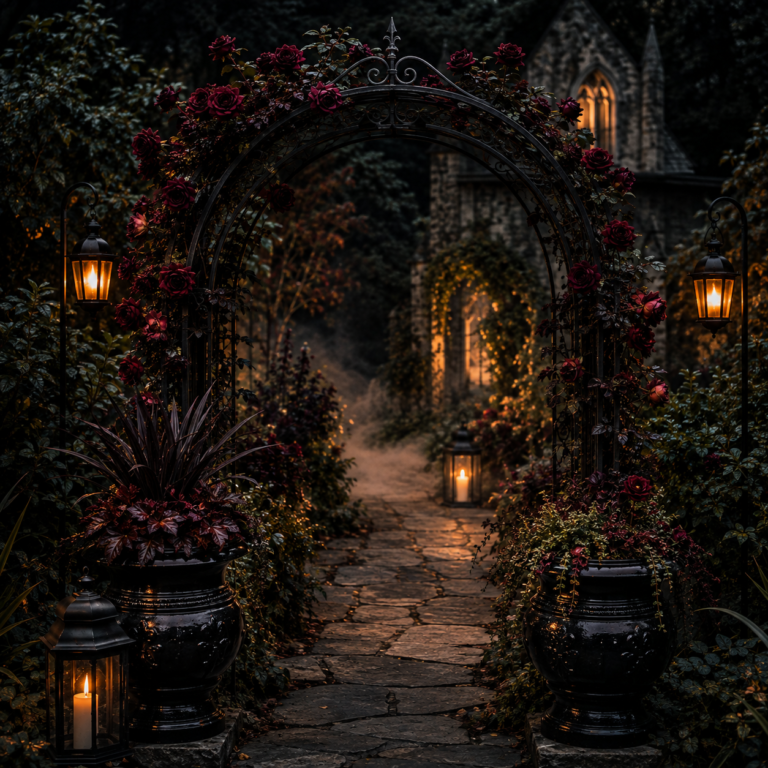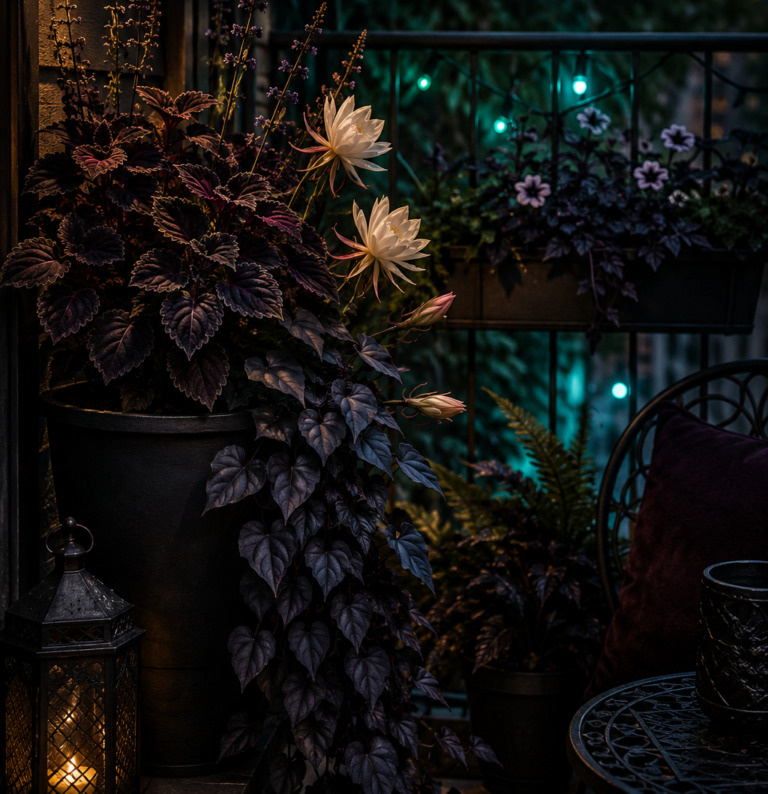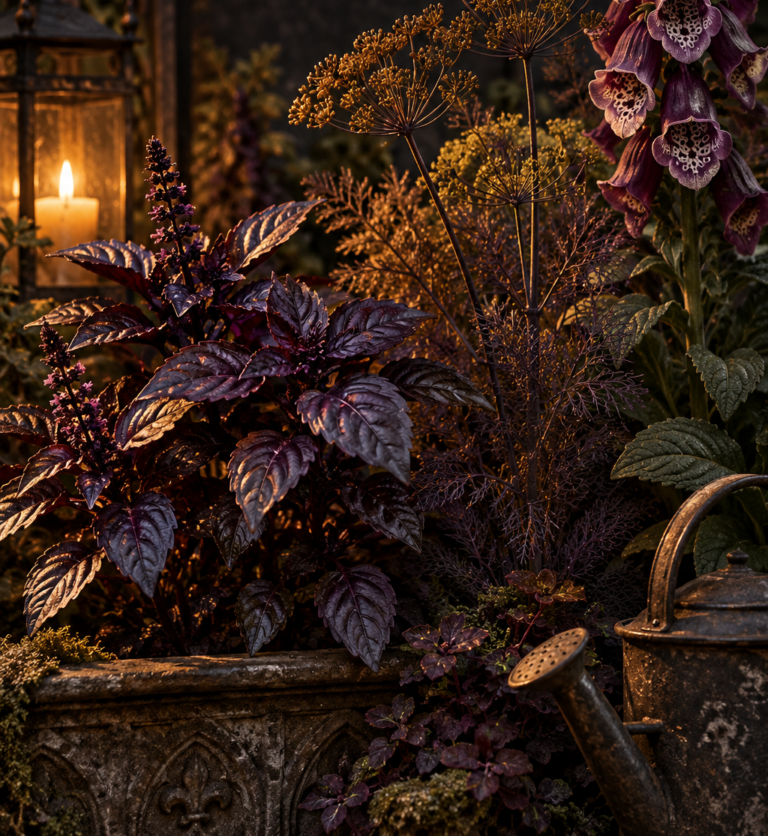
There’s something genuinely magical about a garden that saves its best self for after dark. When the sun drops below the horizon and the rest of the world quiets down, a night garden comes alive — pale blooms glowing in the moonlight, perfume hanging on the warm air, and the soft flutter of moths drawn in from the dark. It’s a sensory experience that daytime gardening simply can’t replicate.
As an Amazon Associate I earn from qualifying purchases and sometimes recommend products from other sellers at no extra cost you. For more details see my disclosure policy and privacy policy. Posts may contain AI generated images to illustrate the content.
A night garden doesn’t have to be an elaborate redesign. Many of the plants that work beautifully after sunset are everyday garden favourites — things you might already have, or can pick up at any big-box garden centre without a specialist search. The real magic is in how you combine them and when you’re there to experience them. Think of this as a space designed for you — for sitting outside with a drink on a warm evening, for lingering after dinner, for watching the moths arrive.
What Makes a Night Garden Work
The core principle is simple: you want your garden to be visually and sensorially interesting after the sun goes down. That means leaning into plants that do something special at night — flowers that open in the evening, fragrances that peak after dusk, and foliage that catches and reflects ambient light.
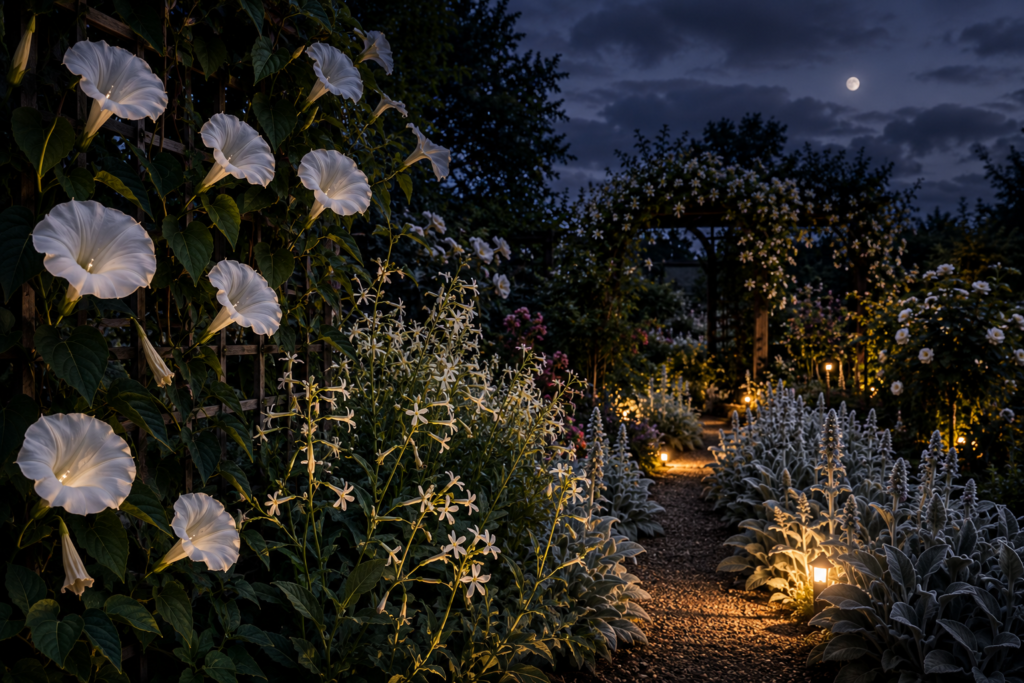
White and pale flowers are your foundation. Under even a thin moon or the gentle glow of solar path lights, white blooms seem to emit their own light. They create what gardeners sometimes call “light pools” — spots in the garden that draw the eye and anchor the space. Silver foliage does the same job for texture and tone, shimmering softly in a way that green leaves simply don’t.
Midnight Decor
3D printed gothic pieces
Darkly beautiful objects for the gothic home — printed fresh when you order. Each piece is conjured for your space and entirely yours.


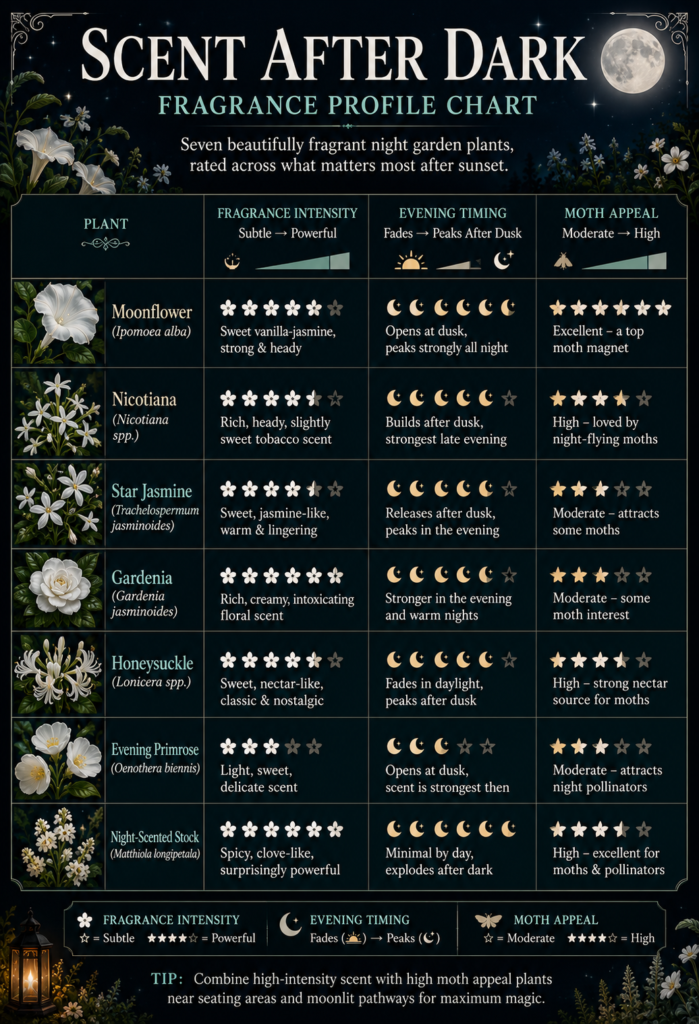
Fragrance is the other essential ingredient. Many plants, like honeysuckle and nicotiana, hold back their scent during the day and release it in the evening as temperatures drop and air becomes more still. Evening fragrance is different from daytime scent — it’s heavier, more concentrated, and it drifts rather than dissipates. Once you’ve experienced a warm evening beside a moonflower vine in full bloom, you’ll plan every garden with this in mind.
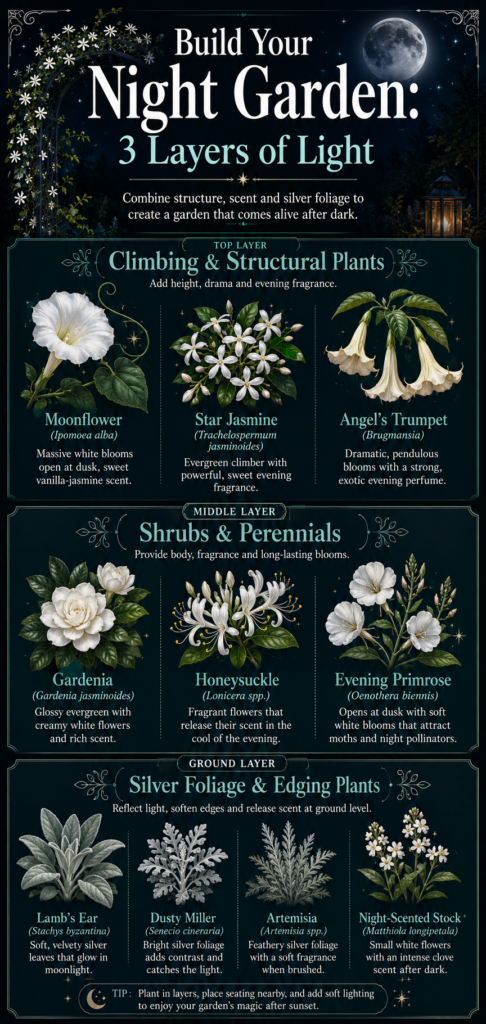
White Flowers That Glow After Dark
Moonflower — The Night Garden Star
If you plant nothing else from this list, plant a moonflower (Ipomoea alba). These climbing vines produce enormous white trumpet flowers — sometimes four to five inches across — that actually unfurl as the light fades at dusk, and close again by morning. Watching them open is genuinely theatrical, and the scent they release is sweet and almost vanilla-jasmine, noticeable from several feet away on a warm night.
Moonflowers are closely related to morning glories and grow in much the same way — fast, vigorous, and happy to climb a trellis, fence, or pergola. They’re annuals in most US climates, but they’re so prolific that they’re worth replanting every year. They’re also one of the best moth-attracting plants you can grow, since the pale colour, evening timing, and trumpet shape are exactly what night-flying pollinators look for.
Nicotiana — Understated and Powerfully Scented
Ornamental tobacco (Nicotiana) is one of those plants that’s easy to overlook in a garden centre — the flowers are small and the foliage isn’t particularly striking. But plant it near somewhere you sit in the evening and you’ll understand why it’s a night garden essential. The scent that opens up after dusk is heady and floral, almost like walking past a perfume counter, and it carries surprisingly far.
White and pale green forms work best for the night garden because they reflect light and remain visible after dark. Nicotiana is straightforward to grow as an annual and pairs beautifully with taller structural plants. Wildlife organisations consistently recommend it as one of the best plants for attracting night-flying moths, which makes it a genuinely worthwhile ecological addition to your garden.
Night-Scented Stock — Small Plant, Enormous Perfume
Night-scented stock (Matthiola longipetala) is a plant that breaks every visual rule. The flowers are tiny and unremarkable, the plant itself is modest in size, and during the day it could easily be mistaken for a weed. But after dark, it releases a spicy, clove-like fragrance so powerful that a few plants near a seating area can scent an entire patio.
Grow it in pots near where you sit, or tuck it along path edges where you’ll brush past it in the evening. It’s inexpensive, easy to direct sow, and asks for very little in return for what it delivers. It’s frequently recommended by the RHS specifically for evening gardens and moth-friendly planting, and it more than earns its place.
White Petunias and Impatiens — Easy Glow Performers
Not every night garden plant needs to be a specialist find. White petunias, white impatiens, white vinca, and white snapdragons are all widely available, easy to grow, and genuinely effective after dark. Under porch lights or solar path lighting, white annuals glow in a way that coloured forms simply don’t — they become luminous anchors that make the whole garden feel intentional rather than accidental.
If you’re starting a night garden from scratch and want quick, reliable results, filling containers and border edges with white annuals gives you an instant foundation while your slower-growing perennials and shrubs get established. Mix them with silver foliage plants (more on those below) for a planting that works from the first evening of summer.
Scented Perennials, Shrubs, and Vines
Star Jasmine — Classic Evening Fragrance
Star jasmine (Trachelospermum jasminoides) is one of the most satisfying plants in the night garden because it gives you everything at once — glossy evergreen foliage that looks good year-round, small pinwheel-shaped white flowers, and a night-time scent that’s genuinely difficult to beat. It’s widely grown across the US South and West, thriving on fences, pergolas, and walls.
The scent is the classic jasmine note — sweet, sultry, and warm — that most people associate with expensive perfume. In the evening, particularly on warm still nights, it becomes heady enough to perfume a whole outdoor space. Plant it near a gate, along a seating area wall, or trained over an arch where you’ll encounter it every time you step outside after dark. If you’re building out your gothic garden, star jasmine is one of the most atmospheric choices you can make.
Angel’s Trumpet — Dramatic and Intoxicating
Angel’s trumpet (Brugmansia) makes a statement even in daylight — it’s a large, dramatic shrub or small tree with enormous pendulous flowers that hang like lanterns from the branches. After dark, those flowers release a heavy, tropical, almost intoxicating fragrance that’s like nothing else in the garden. For anyone who loves the more theatrical side of planting, this is a plant that delivers.
One important note: all parts of Brugmansia are toxic if ingested, so it’s worth being aware of that if you have young children or pets. That said, it’s a widely grown ornamental that poses no risk in a standard garden setting as long as you’re informed. Grow it in a sheltered spot — it’s tender in colder climates and may need winter protection or bringing indoors, but in warmer US regions it can become genuinely spectacular.
Honeysuckle — Nectar-Rich and Generous
Honeysuckle (Lonicera spp.) has a nostalgic sweetness that makes it a sentimental choice for many gardeners, but it’s also a seriously effective night garden plant. Many varieties hold their fragrance until the evening and release it more intensely as temperatures cool, and the tubular flowers are ideal for night-flying moths with long tongues — exactly the wildlife you want to encourage.
White and creamy-flowered forms suit the night garden best, but the fragrance is the real priority here. Honeysuckle is also one of the most generous plants in a wildlife garden more broadly — it provides nectar for adults and host plants for caterpillars, and it’s widely available, easy to establish, and happy to grow over fences, arches, and pergolas with minimal fuss. It pairs naturally with the gothic aesthetic that runs through much of the planting on this site — the same romantically overgrown quality that makes dark garden plants so appealing.
Gardenias — Creamy, Luminous, and Legendary
Gardenias (Gardenia jasminoides) aren’t the easiest plants on this list — they’re particular about drainage, humidity, and soil — but for gardeners in warmer US climates, they’re worth the effort. The flowers are a creamy, luminous white that glows beautifully under low garden lighting, set against glossy dark foliage that adds its own drama. The scent is rich and creamy, often described as jasmine crossed with coconut, and strongest in the evening.
If you can grow gardenias in your climate, they’re one of the most genuinely luxurious plants for an evening garden. Position them where you’ll be able to both see and smell them from a seating area — in a pot on a terrace, or as a low shrub near an outdoor dining space. The combination of scent, pale flower, and dark foliage makes them a natural companion to the kind of atmospheric planting that gothic and dark aesthetics inspire.
Evening Primrose — The Theatrical Opener
Evening primrose (Oenothera) does something worth watching: on warm evenings, the flowers actually open in real time as the light fades. It’s one of those garden moments that feels almost choreographed — a gentle unfurling that takes place over a few minutes and marks the garden’s transition from day to night. The scent is subtle and lemony, but the visual performance is the real attraction.
Plant it somewhere you can watch it — near a path you’ll walk in the early evening, or visible from an outdoor seating area. It’s a hardy perennial, easy to grow, and particularly effective when planted alongside moonflower, which performs a similar evening unfurling on a much larger scale.
Silver Foliage — The Secret Ingredient
Why Silver Plants Are Essential After Dark
Silver foliage is the element that many night garden guides underplay, but experienced gardeners know it’s often as important as the flowers themselves. Under moonlight, soft artificial lighting, or even the faint glow of a well-lit sky, silver leaves shimmer and catch light in a way that green foliage doesn’t — they bring texture and movement to the space and connect the white-flowered plants into a cohesive whole.
They’re also valuable in the daytime, providing a cool, almost metallic quality to the border that works beautifully alongside dark and moody planting — something any reader interested in the gothic garden aesthetic will already understand.
Artemisia — Feathery and Aromatic
Artemisia (wormwood and its silver-leafed relatives) brings a fine, feathery texture and a silvery tone that’s almost luminous in low light. It’s also highly aromatic — bruising the leaves releases a sharp, herbal scent that adds another layer to the evening sensory experience. Use it as a filler between flowering plants to carry the silver thread through the border.
Lamb’s Ear — Soft and Touchable
Lamb’s ear (Stachys byzantina) is one of the most tactilely pleasing plants in any garden, and in a night garden that quality becomes even more significant — you might not be able to see the texture in low light, but you’ll feel it when you run your hand along the border. The large, downy, silver leaves also pick up ambient light better than almost anything else, creating soft pools of pale tone even in quite dim conditions.
It spreads gently to fill gaps, works as a ground cover or border edging, and pairs well with almost anything. For a gothic or dark aesthetic, its almost ghostly pale softness adds an ethereal quality that’s genuinely hard to achieve with other plants.
Dusty Miller — Classic and Reliable
Dusty miller (Senecio cineraria) is a classic for a reason. Its finely cut, silvery-grey foliage is one of the most effective light-reflectors in the garden, making it ideal for catching the glow from path lights and porch fixtures and directing attention along the border. Widely available as a bedding plant, it’s easy to use and very effective for quick results.
Building a Moth-Friendly Border
One of the most rewarding things you can do with a night garden is design it with pollinators in mind — specifically moths, which are significant nocturnal pollinators that often go unrecognised for the ecological role they play. The good news is that what moths want and what makes a beautiful night garden are almost identical: pale flowers, evening fragrance, trumpet or tube shapes with accessible nectar, and blooms that stay open after dark.
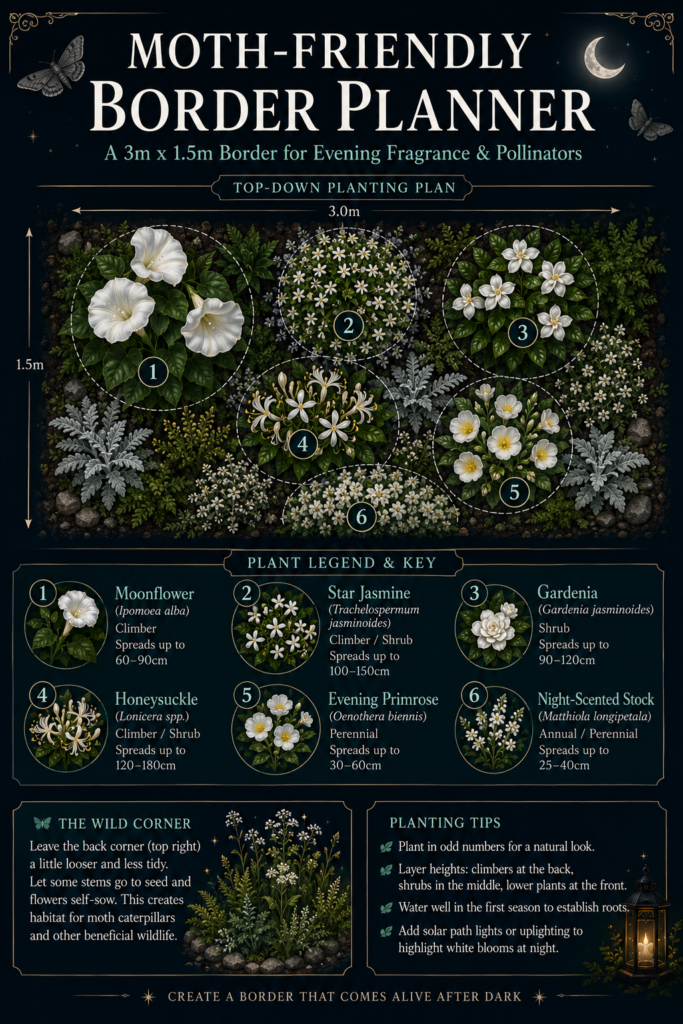
A dedicated moth-friendly corner might include moonflower for the dramatic evening display, nicotiana for its intense after-dark scent, night-scented stock for its spicy perfume, honeysuckle for nectar-rich tubes, evening primrose for the theatrical performance, and star jasmine for the classic fragrance. That combination covers all the bases — visual, scent, and shape — and creates a planting that functions as both a beautiful garden space and a genuine wildlife habitat.
It’s also worth leaving a “wild corner” if you have space — an area where native plants and even some weedy species can establish themselves. Bramble, willowherb, and similar plants provide host plants for caterpillar species, not just nectar for adult moths. These plants benefit the wider ecosystem and, depending on your tolerance for the untamed, can add a romantically overgrown quality that suits a dark-aesthetic garden beautifully.
How to Light a Night Garden Without Ruining It
Lighting is where many night gardens go wrong — either too much, which turns a dreamy evening space into a car park, or too little, which means you can’t see anything at all. The goal is to amplify what the plants are already doing, not to overpower them.
The key principles are:
- Light for people, not the whole sky. Focus on safety areas — steps, path edges, and seating — rather than flooding the entire garden with brightness.
- Use warm tones. Warm amber and gentle golden light is far less disruptive to nocturnal wildlife than cool white or blue-white LEDs, and it’s more flattering to the garden overall.
- Keep it low and directed. Path lights, discreet fixtures hidden among rocks or at plant bases, and low spotlights work better than bright uplighting or high-mounted floodlights.
- Use timers. Giving the garden genuine darkness for part of the night is beneficial both for wildlife and for the quality of the experience — not every moment needs to be lit.
Solar path lights along walkways give a gentle, low-level glow that’s ideal for guiding you through the garden without competing with the plants. A couple of discreet spotlights under small trees or at the base of large architectural plants can create theatrical pools of light that feel intentional and dramatic. Skip lighting ponds directly — it attracts and disorients flying insects in ways that can be harmful.
Think of the lighting as supporting the plants rather than replacing them. White blooms and silver foliage do most of the work — the lighting just gently amplifies what’s already there.
Getting Started: Your Night Garden Plan
You don’t need to overhaul your entire garden to get the night garden experience. A single container near a seating area — a pot of moonflower training up a trellis, surrounded by white petunias and lamb’s ear at the base, with a pot of night-scented stock just close enough to catch on warm evenings — is enough to understand what the whole concept is about.
If you want to go further, start by identifying the spots in your garden where you actually spend time in the evening: a terrace, a bench, a path you walk to come inside. Then build outwards from those spots, adding white flowers and silver foliage progressively. The gothic garden guide on this site covers the broader aesthetic framework, while the dark plants guide is worth reading for the moody foliage that might sit alongside your lighter night garden planting.
The night garden is one of those garden ideas that feels immediately right once you experience it. A warm summer evening, pale flowers glowing in the near-dark, the scent of jasmine or moonflower on the air, and the quiet flutter of a moth visiting the nicotiana — there’s very little that beats it.
Conclusion
A night garden is one of the most rewarding garden ideas you can explore — not because it’s complicated, but because the results are so immediately and genuinely pleasurable. White and silver plants, evening fragrance, and a thoughtful approach to lighting transforms any outdoor space into somewhere you actually want to be after dark.
Start small, plant the things you’re most drawn to from this list, and spend some evenings in the garden paying attention to what’s happening. The moths will find you. The scent will surprise you. And once you’ve experienced a moonflower opening at dusk, you’ll never design a garden without thinking about what it does after the sun goes down.
Continue Your Journey:
- The Gothic Garden: Your Complete Guide to Dark Foliage, Black Flowers, and Moody Night Gardens — the full framework for gothic-influenced outdoor planting
- The Best Dark Plants for a Gothic Garden: From Near-Black Flowers to Moody Foliage — moody foliage and dark-toned plants that pair beautifully with night garden planting
- Gothic Living Room Decor Guide: How to Build a Moody, Romantic Space You’ll Never Want to Leave — bring the same atmosphere indoors
- Creating a Gothic Reading Nook: Your Personal Dark Academia Sanctuary — another space designed for evening retreats
Enjoyed this guide? Subscribe to The Gothic World newsletter for more dark garden inspiration, beauty guides, and interiors content delivered directly to your inbox.
What’s your must-have night garden plant? Drop your answer in the comments below — I’d love to know what’s growing in your after-dark space.