Most gardening advice assumes you want your outdoor space to look bright, cheerful, and full of pastel blooms. If that’s not you, the internet has historically had very little to offer beyond a seasonal Halloween prop list. Once the plastic tombstones come down in November, gothic homeowners are left to figure out the actual bones of a moody garden on their own.
As an Amazon Associate I earn from qualifying purchases and sometimes recommend products from other sellers at no extra cost you. For more details see my disclosure policy and privacy policy. Posts may contain AI generated images to illustrate the content.
This is that guide. Not the plants (we’ve already covered the best dark plants for a gothic garden and the full gothic garden plant guide if foliage is what you’re after) but the hard elements underneath them: the structures, the lighting, the water features, and the containers that give a gothic garden its identity whether anything is in bloom or not. This is an aesthetic you live in year-round, not a display you pack away after 31 October.
⚔️ Structural pieces: arches, trellises, and obelisks
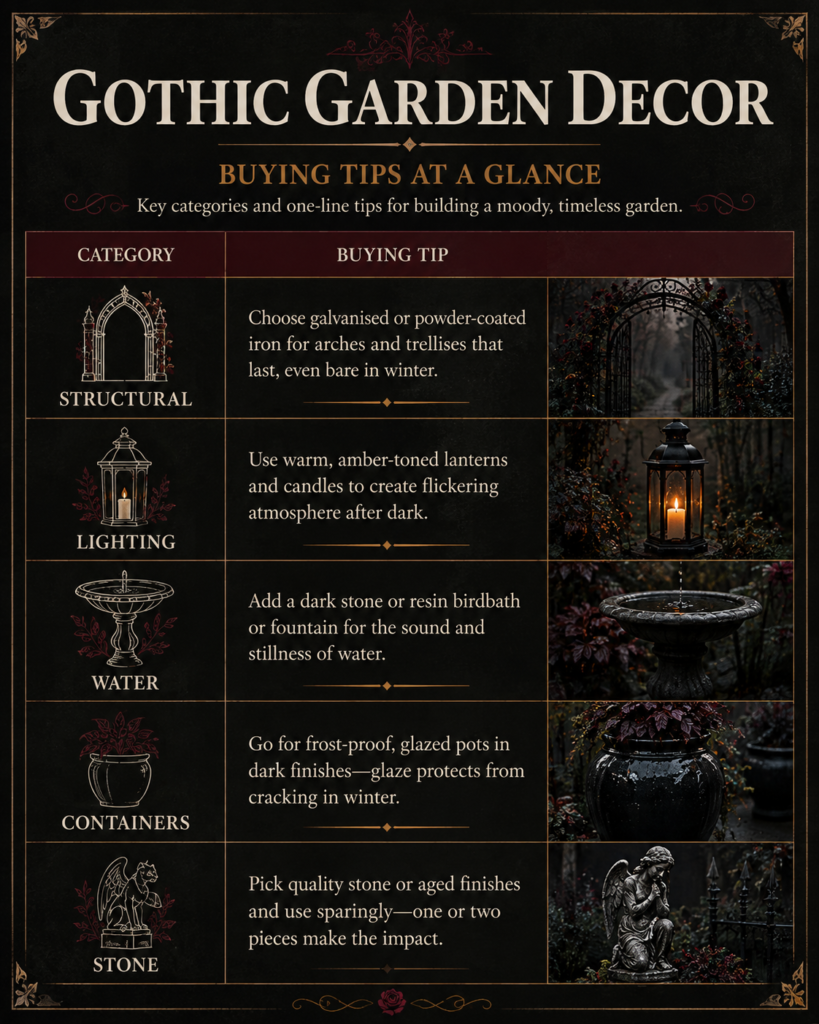
Structure is what separates a gothic garden from a garden that just happens to have some black flowers in it. Iron arches and arbours give you an instant focal point and a frame for climbing plants like roses, clematis, or jasmine to grow through, which is exactly the kind of “looks like it’s always been here” effect that reads as lived-in rather than staged.
Look for galvanised or powder-coated iron rather than painted steel that will flake within a season. A wrought iron arch with a gothic spire or pointed silhouette does a lot of the visual work on its own, even bare in winter. Obelisk trellises are the smaller-footprint option if you’re working with a patio or a narrow border rather than a full arch, and they double as sculptural pieces even before anything climbs them.
Midnight Decor
3D printed gothic pieces
Darkly beautiful objects for the gothic home — printed fresh when you order. Each piece is conjured for your space and entirely yours.


🕯️ Lighting: lanterns and candlelight for evening atmosphere
A gothic garden earns its keep after dark. Lanterns, hanging candle holders, and warm-toned string lighting turn the space into something you actually want to sit in once the sun goes down, rather than something you only look at from a window.
Stick to warm, amber-toned light rather than cool white or colour-changing LEDs. The goal is candlelight, not a garden centre display. Freestanding iron lanterns along a path or by a seating area give you that flicker without an open flame if you’re not keen on maintaining real candles outdoors.
🌑 Water features: birdbaths and dark stone fountains
Moving or still water adds a genuinely different sensory layer to a garden, and a dark stone or resin birdbath does it without tipping into anything twee. Look for finishes in charcoal, aged bronze, or black rather than the pale stone or bright ceramic finishes most garden centres default to.
If you’ve got the space and budget for a small fountain, a dark stone tiered design gives you the sound of water without the scale (or the pump maintenance) of a full pond. Even a modest birdbath does a lot to soften a garden that’s otherwise mostly iron and stone.
🪴 Containers: dark, durable pots for every season
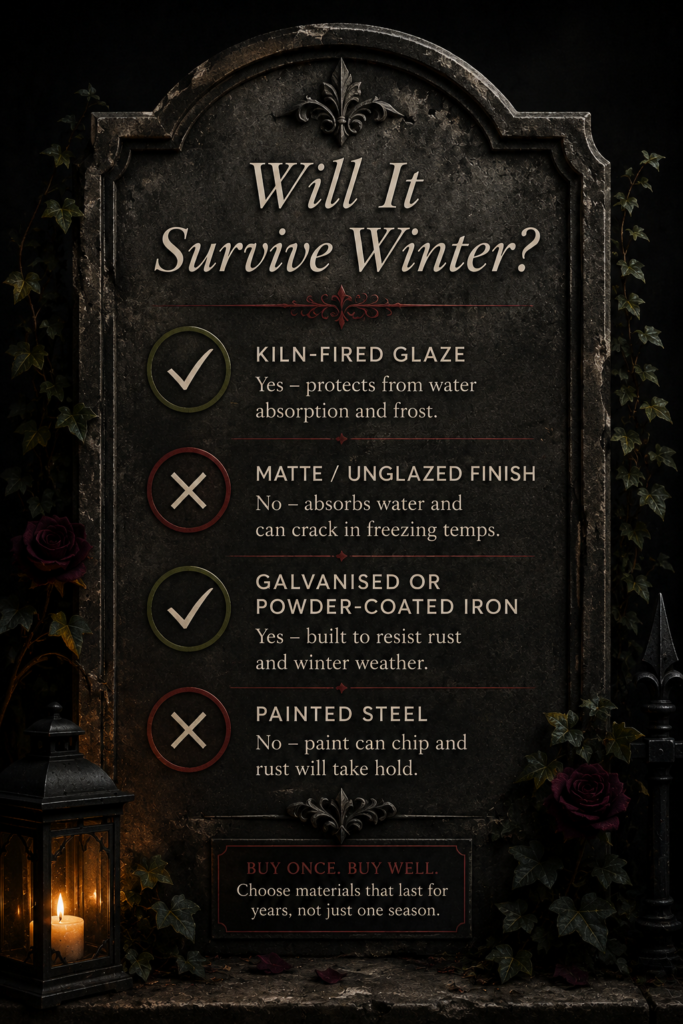
Containers are where a lot of gothic garden plans quietly fail, because black planters left outside through a wet winter are notorious for cracking. The fix is glaze, not colour. A kiln-fired glaze on a low-absorption clay body (sometimes labelled “frost-proof”) seals the surface so water can’t get in and split the pot when it freezes. Matte or unglazed dark finishes are the ones to be wary of if your winters dip below freezing.
Buy the largest pots your budget allows. Bigger containers hold moisture more evenly, insulate roots better in cold snaps, and simply read as more substantial next to iron structural pieces. A set of graduated dark glazed pots either side of a doorway or arch is a classic pairing for a reason.
🗿 Stone ornaments: statuary and edging that stays tasteful
This is the category where it’s easiest to tip over into costume territory, and the one to be most deliberate about. Statuary, memorial-style accents, and stone edging can absolutely read as elegant and intentional, but they can also read as a Halloween yard display if they’re cheap resin in a bright finish with no weathering.
Look for genuine stone, cast stone, or a well-aged resin finish rather than glossy plastic for your garden statue. Weathered grey, charcoal, or moss-toned pieces blend into planting rather than sitting on top of it. Use these sparingly. One or two well-placed pieces (a single urn, a stone edging border, a modest statue tucked into planting) reads as considered. A dozen scattered ornaments reads as a display.
🕸️ Styling tip: layering it so it reads as identity, not a display
The difference between a gothic garden and a Halloween yard comes down to permanence and restraint. A Halloween display is temporary, dense, and meant to be seen from the street. A gothic garden is something you built to live in, and it should look that way: structural pieces that stay up year-round, plants and containers that are genuinely cared for, and ornamental touches that are sparse enough to feel chosen rather than piled on.
Start with one structural piece (an arch, an obelisk, a single large planter) and build outward from there over a season or two rather than trying to furnish the whole space at once. If you want to bring the same aesthetic indoors once the structure outside is sorted, our gothic entryway and hallway decor guide picks up right where the front door leaves off. And if plants are the part you haven’t tackled yet, night garden plants is the natural next stop once the containers and structure are in place.